Is it cheaper to 3D print or buy? Usually buying wins on cheap, mass-produced items, and printing wins on custom, hard-to-find or high-priced parts. Material for a small print costs cents, but a $179 printer needs dozens of avoided purchases to pay for itself, so the answer depends on what you print and how many.
If you only read one thing. Break-even parts = printer cost / (shop price - cost to print one). The cost to print one is small, so the printer price is what you are really repaying. Shop prices in the examples are illustrative; the printer and filament prices are sourced and dated.
Is it cheaper to 3D print something or buy it?
It is cheaper to print only when the saving on each part, multiplied by the number of parts, outweighs the cost of the printer and your time. The material is the easy part: a 35 g part costs about 58 cents including a waste allowance and electricity (worked through in 3D printing cost per print). That figure uses Elegoo's $13.99 per kg PLA price and the 18.31 cents per kWh US residential average, with illustrative weights, hours and power draw.
Three situations tilt toward printing:
- The part does not exist on a shelf. A bracket for an odd appliance, a custom organizer insert or a discontinued clip has no shop price to compare with.
- The shop price is high for the plastic in it. Branded accessories and small proprietary parts often cost many times their material cost.
- You need one, quickly, at no shipping cost. Waiting days for a $4 part with $6 shipping is a cost too.
Three situations tilt toward buying:
- The item is cheap and mass-produced. Injection-molded items sold for a dollar or two leave a printer very little saving per part.
- The part is safety-critical or load-bearing. Plastic printed on a hobby machine is not a drop-in replacement for a rated component. Follow the original part's guidance, not a print-cost spreadsheet.
- You value your time highly. Finding or drawing a model, slicing, printing and cleanup take time even when the printer runs unattended.
How many prints does it take to pay for a 3D printer?
The break-even count is the printer price divided by the saving per part. The table uses two real printer prices from the makers' US stores on 2026-10-19: the Creality Ender-3 V3 SE at $179 and the Elegoo Centauri Carbon 2 at $349 (struck through from $359). It assumes each part costs about $0.58 to print (the phone stand example) and that the printed part works as well as the one you would buy. Shop prices are illustrative.
| Illustrative shop price | Saving per part | Parts to repay a $179 printer | Parts to repay a $349 printer |
|---|---|---|---|
| $2 | $1.42 | 127 | 246 |
| $5 | $4.42 | 41 | 79 |
| $10 | $9.42 | 20 | 38 |
| $20 | $19.42 | 10 | 18 |
Each count is rounded up to a whole part. For example, at a $10 shop price the saving is $10 - $0.58 = $9.42, and $179 / $9.42 = 19.0, so 20 parts. The table ignores filament you waste on failed prints, tax, shipping on both sides, replacement parts and your time. Each of those pushes break-even further out, which is why the first-year picture matters; see the first-year cost of owning a 3D printer.
What does it really cost to 3D print one part?
The material and electricity cost is a few cents to a few dollars, as the 3D printer running costs guide and the electricity cost guide show. The costs people leave out are:
| Cost | Usually in the comparison? | Note |
|---|---|---|
| Filament | Yes | $13.99 per kg for 1 kg of Elegoo PLA on 2026-10-19; $10.50 per kg in a 10 kg pack |
| Electricity | Sometimes | Cents per print at typical rates |
| Failed prints and tests | Rarely | Add a waste allowance; 10% is an assumption |
| Wear parts | Rarely | Nozzle kit $9.99 and a three-plate pack $39.99 on Elegoo's US store, 2026-10-19 |
| The printer | Often skipped | The biggest item at low volumes |
| Your time | Almost never | Not a cash cost, but the usual reason people buy |
When is 3D printing clearly cheaper?
Printing is clearly cheaper when you make many copies of something with a real shop price, or when nothing equivalent can be bought. Some examples that need no shop price to justify: replacement knobs and clips for appliances, cable and desk organizers fitted to your own furniture, and one-off jigs. Free models exist for a lot of these; where to find 3D models lists sources, so you may not need to design anything.
The printer pays off fastest when you already have a reason to own one. If you are buying a machine only to save money on cheap shop items, the numbers above say the hobby is an expense, not a saving. Is 3D printing worth it gives the broader view, and how much a 3D printer costs shows what the machines cost.
What mistakes make printing look cheaper than it is?
- Comparing plastic to a finished product. The shop price includes the maker's tooling and margin; your cents of filament leave out the machine that made them.
- Ignoring failed prints. One failure in ten adds about a tenth to the material cost. The 10% allowance in the cost guide is an assumption you can change.
- Counting only the first part. The break-even table shows why: the saving per part is small, so the count matters.
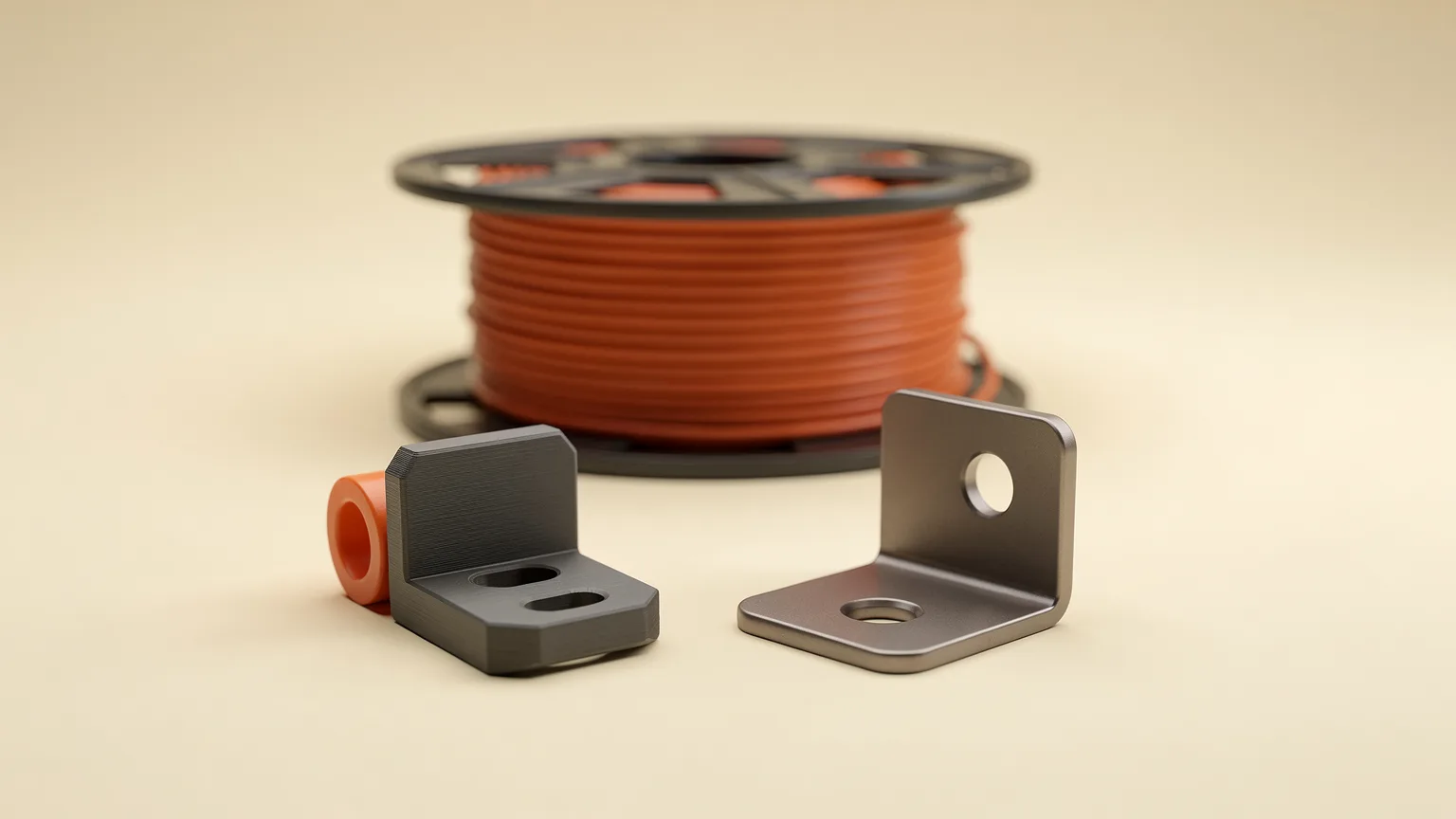
- Assuming the printed part is as good. Printed plastic can be weaker, warp in heat or look rougher than a molded part. Match the material to the job; types of 3D printer filament covers the options.
- Forgetting the learning curve. Early prints fail more often, which raises your real cost per good part.
A worked example with a custom part
Suppose a replacement cover for an appliance is sold by the maker for an illustrative $18 plus $7 shipping, and a printed version weighs 25 g and takes 1.5 hours. Material at $13.99 per kg with 10% waste is 27.5 g x $0.01399 = $0.38, and electricity at an assumed 100 W and 18.31 cents per kWh is 0.15 kWh x $0.1831 = $0.03. The printed cover costs about $0.41, against $25 to buy, a saving of about $24.59. At that saving, a $179 printer is repaid by the eighth such part. The example is deliberately a good case for printing; most shelf items are not.
A simple way to decide
- Price the shop version, including shipping.
- Price the printed version with the formula or the print cost calculator.
- Subtract the two. If the saving is under about a dollar, buy it unless you need a custom fit.
- If you do not own a printer, divide its price by the saving, and ask whether you will really make that many parts.
- Check the part's job. If it carries load or sits near heat, buy the rated part.