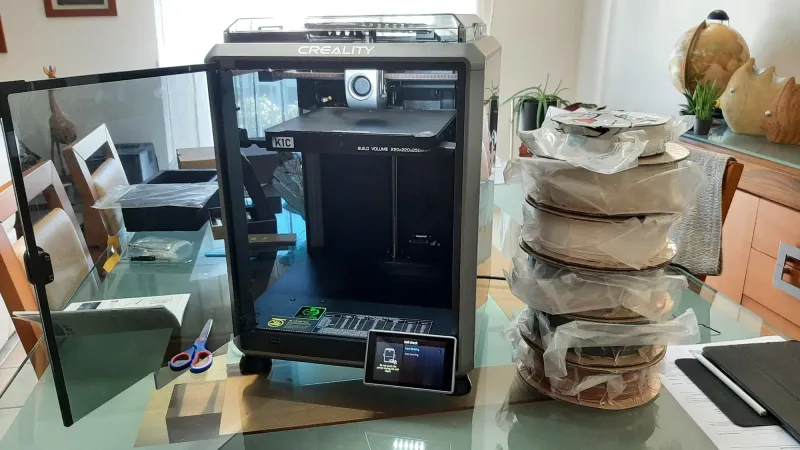
The first-year cost of owning a 3D printer is the printer price plus filament, a little electricity and some spare parts. On sourced prices, an illustrative light-use year costs about $235 with a $179 printer, and a heavy-use year about $701 with a $349 printer, with the printer itself the largest single line in most cases.
How to read this. Printer, filament, nozzle, plate, dryer and electricity prices below are from named store pages and the US Energy Information Administration, read on 2026-10-19. How many kilograms you print and how many hours the printer runs are illustrative assumptions, labeled as such.
How much does it cost to own a 3D printer in the first year?
It costs the purchase price plus roughly $50 to $350 of running and spare costs, depending on how much you print. The printer prices used are the two cheapest in our price guide that are on makers' US stores: the Creality Ender-3 V3 SE at $179 and the Elegoo Centauri Carbon 2 at $349 (struck through from $359). For other models, see how much a 3D printer costs.
| Line item | Light year | Typical year | Heavy year |
|---|---|---|---|
| Filament used (illustrative) | 3 kg | 8 kg | 20 kg |
| Filament cost | $41.97 | $111.92 | $209.98 (two 10 kg packs) |
| Print hours at an assumed 100 W | 200 h | 500 h | 1,200 h |
| Electricity at 18.31 cents per kWh | $3.66 | $9.16 | $21.97 |
| Nozzle kit | $9.99 | $9.99 | $9.99 |
| Spare build plates (3-pack) | none | $39.99 | $39.99 |
| Filament dryer | none | none | $70.00 |
| Running and spares total | $55.62 | $171.06 | $351.93 |
| First year with a $179 printer | $234.62 | $350.06 | $530.93 |
| First year with a $349 printer | $404.62 | $520.06 | $700.93 |
The sums: light is $41.97 + $3.66 + $9.99 = $55.62; typical is $111.92 + $9.16 + $9.99 + $39.99 = $171.06; heavy is $209.98 + $21.97 + $9.99 + $39.99 + $70.00 = $351.93. Add each to the printer price for the first-year total. Prices exclude tax and shipping, which differ by store and place.
Where do the line-item prices come from?
- Printers. Creality's US store listed the Ender-3 V3 SE at $179, and Elegoo's US store listed the Centauri Carbon 2 at $349, both on 2026-10-19.
- Filament. Elegoo listed 1 kg of PLA at $13.99 and a 10 kg pack at $104.99 (struck through from $140.00). The light and typical years use the 1 kg price, 3 x $13.99 and 8 x $13.99. The heavy year uses two 10 kg packs at $104.99 each. See how much filament costs for other materials, and how long a filament spool lasts to judge your own usage.
- Electricity. The US residential average was 18.31 cents per kWh in July 2026 (EIA, preliminary, released September 24, 2026). At an assumed 100 W average, 500 hours is 50 kWh, or $9.16. Your printer's real draw is different; see 3D printer electricity cost.
- Spares. Elegoo listed a 0.4 mm brass nozzle kit at $9.99 and a three-plate dual-sided build plate pack for its Centauri series at $39.99. Check that any part fits your own printer before you buy.
- Dryer. Elegoo listed its H1 HT filament dryer at $70.00. Whether you need one is covered in how to choose a filament dryer.
What does a 3D printer cost beyond the sticker price?
Beyond the sticker price you pay for consumables, wear parts and the extras that the first few months reveal. A realistic list is:
- Filament, by far the biggest running cost. Your slicer's gram figure turns into dollars with the method in 3D printing cost per print.
- Wear parts. Nozzles and build plates age, and abrasive filaments wear nozzles faster. Maintenance tasks are in the maintenance checklist.
- Upgrades. Optional: an enclosure, a dryer, better storage. First 3D printer upgrades says which are worth it. Only the dryer is priced above.
- Small tools and accessories, such as a scraper, cutters and spare tubing. The starter kit guide lists them; their prices are not included in the totals here.
- Failed prints. Part of the filament line, so a heavy failure rate raises it.
- Your time, which is the cost that never appears on an invoice.
Is the first year the most expensive year?
Yes for most owners, because the printer is a one-off purchase and the later years are consumables and the occasional spare. In the typical column above, running and spares come to $171.06; a second year would not repeat the printer's $179 or $349 and might not repeat every spare. That is a sketch from the assumptions above, not a forecast, since your usage and failures decide it.
Whether the outlay is worth it depends on what you make; is it cheaper to 3D print or buy works through break-even, and is 3D printing worth it covers the non-money side. If you want a first machine on a budget, best budget 3D printers compares options.
What changes in year two?
The printer purchase drops out, so year two is the running and spares column. Three things change. Filament use usually settles once the learning prints are done, so your first-year figure may overstate it. Wear parts appear on a schedule: nozzles and plates age with print hours, and a printer's maintenance guide tells you when. The third is upgrades, which depend on what you run into. If you outgrow the machine you may buy a second one, which resets the printer line. None of this can be priced in advance, so treat the typical column as a planning figure, not a promise.
How can you keep the first-year cost down?
- Buy the printer you need now. A $179 printer in the light-year column is $170 cheaper than the $349 printer in the same year.
- Skip optional extras until a real need shows up. The dryer adds $70 only in the heavy column.
- Buy filament in a larger pack once you know your usage. On the same Elegoo page the 10 kg pack was about $10.50 per kg against $13.99.
- Keep failures low. Fewer failed prints means less wasted plastic and fewer worn parts.
All of this is desk research from store pages and published electricity data. It describes what the parts and plastic cost, not how any particular printer performs.