How Much Does 3D Printer Filament Cost?
PLA typically costs $14 to $20 per kilogram from mainstream makers, with engineering filaments several times higher. Dated store prices, cost per gram and ways to spend less.
By Sepehr Sabbagh-pour · Published 10 October 2026 · 7 min read
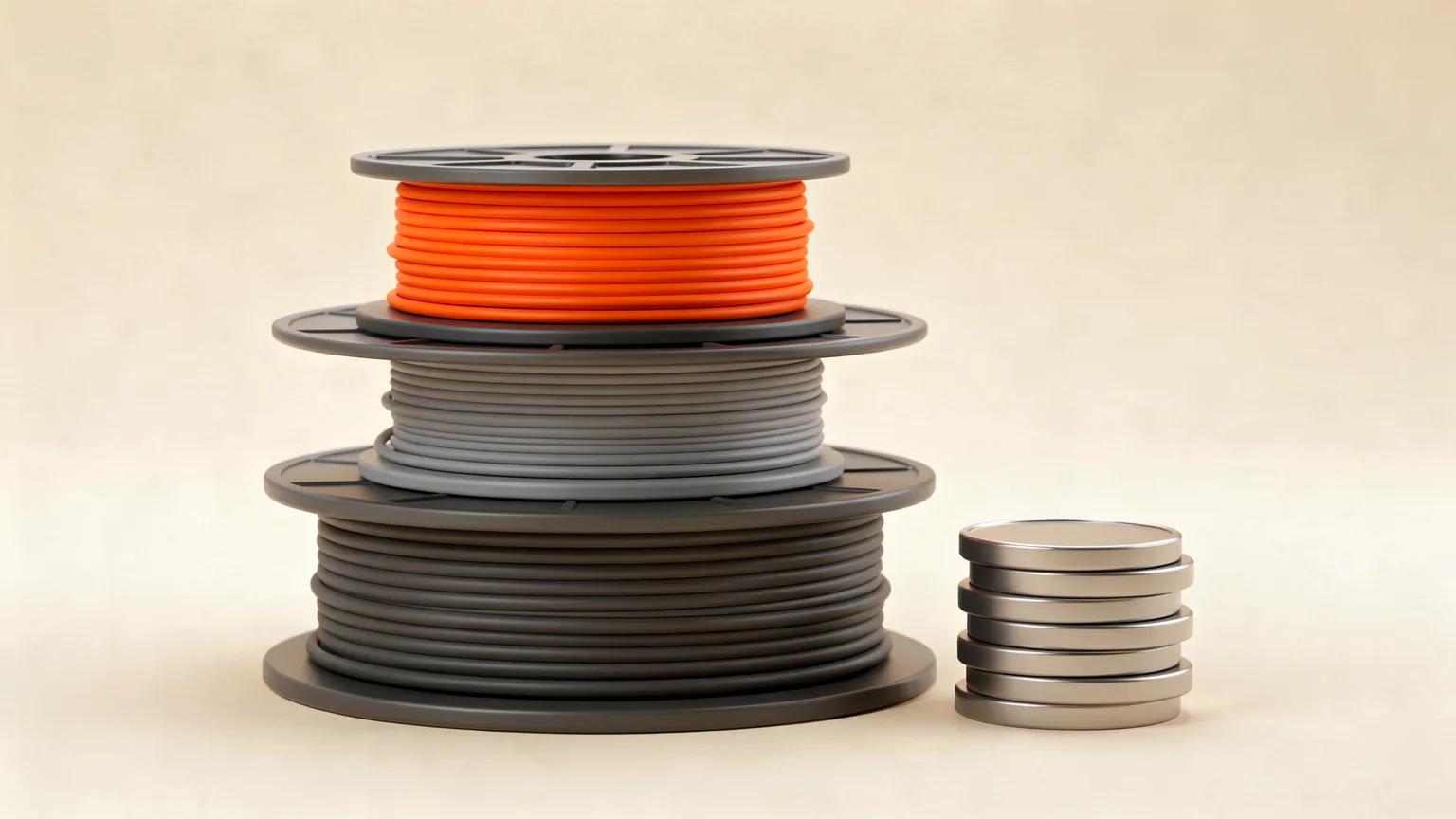
A standard 1 kg spool of PLA costs roughly $14 to $20 from mainstream makers, and the same weight of engineering material can cost several times that. This guide lists current prices taken from maker store pages, converts them into a cost per gram and per print, and explains what pushes a spool up or down in price.
This is a research article. Prices come from the store pages listed in the sources, checked on 2026-10-10, and they change often. Stores show different currencies depending on where you are, so each price below names the store region it was seen in. Always check the live listing before you buy.
The short answer
- Budget PLA: $13.99 to $14.99 per 1 kg spool at Elegoo's US store.
- Mainstream PLA: $19.99 for a 1 kg spool of Polymaker PolyLite PLA at its US store, and £16.99 for Bambu Lab PLA Basic with a spool at its UK store.
- Premium PLA: £29.99 for a 1 kg spool of Prusament PLA at Prusa's store (UK pricing shown).
- Engineering and composite filaments: from £27.99 (ASA) up to £70.99 or more per kilogram (carbon fiber nylon) at Bambu Lab's UK store.
Filament prices by brand and material
The table shows list prices for a single 1 kg spool unless a different weight is stated. Prices include whatever tax the store displayed in that region.
| Filament | Store region | Price seen (2026-10-10) | Per gram |
|---|---|---|---|
| Elegoo PLA, 1 kg | US store | $13.99 | 1.4 cents |
| Elegoo PLA Plus, 1 kg | US store | $14.99 | 1.5 cents |
| Elegoo Silk PLA, 1 kg | US store | $18.99 | 1.9 cents |
| Polymaker PolyLite PLA, 1 kg | US store | $19.99 | 2.0 cents |
| Bambu Lab PLA Basic, 1 kg refill (no spool) | UK store | £13.99 | 1.4p |
| Bambu Lab PLA Basic, 1 kg with spool | UK store | £16.99 | 1.7p |
| Bambu Lab PETG HF, 1 kg with spool | UK store | £16.99 | 1.7p |
| Bambu Lab ABS, 1 kg with spool | UK store | £16.99 | 1.7p |
| Prusament PLA, 1 kg | Prusa store, UK pricing | £29.99 | 3.0p |
| Prusament PETG, 1 kg | Prusa store, UK pricing | £29.99 | 3.0p |
| Bambu Lab ASA, 1 kg with spool | UK store | £27.99 | 2.8p |
| Bambu Lab TPU for AMS, 1 kg with spool | UK store | £34.99 | 3.5p |
| Bambu Lab PLA-CF, 1 kg with spool | UK store | £32.99 | 3.3p |
| Bambu Lab PA6-CF, 1 kg with spool | UK store | £70.99 | 7.1p |
| Bambu Lab PET-CF, 1 kg with spool | UK store | £78.99 | 7.9p |
Per-gram figures are simple division of the listed price by 1,000 g. Bambu Lab's US store address redirected to its UK store when checked, so those prices are in pounds. The US and UK numbers are not a like-for-like comparison, because the currency, tax treatment and shipping differ.
What a spool costs per print
Price per kilogram only matters once you know how much plastic a print uses. Your slicer reports the weight of filament a job needs, and that figure times the price per gram gives the material cost. For a 100 g print, the arithmetic from the table above is:
- Elegoo PLA: about $1.40.
- Polymaker PolyLite PLA: about $2.00.
- Bambu Lab PLA Basic with spool: about £1.70, or £1.40 from a refill.
- Prusament PLA: about £3.00.
- Bambu Lab PA6-CF: about £7.10.
Material is only part of running a printer. Electricity, nozzles and wear parts add to it, which our 3D printer running costs guide and the print cost calculator cover. For the power side alone, see electricity cost per 3D print.
Why prices differ
Material type
PLA, PETG and ABS are the cheapest because they are mass-produced commodity plastics. TPU, ASA and polycarbonate cost more. Carbon fiber and glass fiber filled filaments, and nylon blends, sit at the top. Bambu Lab's own UK listings show the pattern: PLA, PETG HF and ABS at £16.99, ASA at £27.99, TPU for AMS at £34.99, and PA6-CF at £70.99 for 1 kg (£37.99 for 0.5 kg).
Spool or refill
Bambu Lab sells many of its filaments as a refill without a spool. In the UK store, PLA Basic is £13.99 as a refill and £16.99 with a spool, a £3.00 gap. Its wiki describes a reusable spool designed to cut plastic waste in the feeding system by at least 20%. A refill only makes sense if you already own reusable spools, since you load the coil onto one yourself. See the Bambu Lab filament guide for how that works.
Multi-spool pricing
Large spools lower the cost per kilogram. Polymaker lists PolyLite PLA at $19.99 for 1 kg, $49.99 for 3 kg and $79.99 for 5 kg on its US store. That works out to $16.66 per kg for the 3 kg spool and $16.00 per kg for the 5 kg spool, against $19.99 for a single kilogram. Check that your printer and spool holder can take the bigger spool before you commit.
Brand, quality control and extras
Premium makers point to tighter tolerances, color consistency and published data. Prusa states that every Prusament spool is made in-house to a diameter precision of ±0.02 mm and ships with measured data for that spool. Elegoo also lists a ±0.02 mm tolerance for its PLA at a much lower price, and Bambu Lab lists ±0.03 mm for PLA Basic. So the tolerance number alone does not explain the price gap. Our cheap vs premium filament guide looks at what else you are paying for.
Size and diameter
Most consumer printers use 1.75 mm filament. 2.85 mm filament is a different product for a small group of machines, covered in 1.75 mm vs 2.85 mm filament. Spool weights vary too, so always compare price per kilogram, not price per spool.
How to spend less without hurting your prints
- Match the material to the job. PLA covers most models and prototypes. Pay for PETG, ASA or nylon only when heat, impact or weather demands it. PETG vs PLA explains the trade-off.
- Buy the big spool of colors you use most. A 3 kg or 5 kg spool of black or white PLA lowers the per-kilogram price if you print often.
- Use refills if you own reusable spools. It saves the spool premium on every purchase.
- Do not skimp on storage. Damp filament causes stringing and weak layers, which wastes more plastic than a cheap spool saves. See how to store filament.
- Weigh print settings against cost. Lower infill and fewer walls use less filament, but test that the part is still strong enough for its job.
Country notes
Prices on maker stores vary by region because of tax, shipping and local stock. Bambu Lab's prices above are from its UK store and Prusa's are the GBP prices shown for the United Kingdom, while Elegoo and Polymaker prices are from their US stores. If a maker ships from a local warehouse, you avoid import duty and long delivery times, which can matter more than a pound or two per spool. Bambu Lab's UK store page states orders ship from a UK warehouse in 1 to 3 business days.
Frequently asked questions
How much does a spool of 3D printer filament cost?
A 1 kg spool of PLA was listed at $13.99 to $19.99 on US maker stores and £13.99 to £29.99 on UK-priced stores on 2026-10-10. Engineering materials cost more, up to around £79 per kilogram for PET-CF at Bambu Lab's UK store.
What is the cheapest filament to buy?
PLA is normally the cheapest, followed by PETG and ABS. Elegoo listed standard PLA at $13.99 per 1 kg on its US store on 2026-10-10. Specialty finishes such as silk PLA cost a few dollars more.
How much does it cost to print a 100 g part?
Multiply the weight by the price per gram. At $13.99 per kg a 100 g print uses about $1.40 of filament, at $19.99 per kg about $2.00, and at £29.99 per kg about £3.00. Electricity and wear are extra.
Is a bigger spool cheaper per kilogram?
Often yes. Polymaker listed PolyLite PLA at $19.99 for 1 kg, $49.99 for 3 kg ($16.66 per kg) and $79.99 for 5 kg ($16.00 per kg) on its US store. Check your printer can hold the larger spool.
Why is some filament so much more expensive?
Material type is the main driver. Carbon fiber, glass fiber and nylon-based filaments cost several times more than PLA. Brand, quality control, spool type and refill versus full spool also change the price.
Sources

Founder and editor
Software engineer since 2009 and Head of Engineering by day, a maker who has owned several 3D printers, writing practical guides to 3D printers, filament and running costs, with every article saying what was and was not tested.
Keep reading
PETG Print Temperature: Nozzle and Bed Settings
Prusa recommends 240 degrees C at the nozzle and 85 to 90 on the bed for PETG; Polymaker lists 240 to 260 and 60 to 70. Settings, cooling and tuning steps.
10 October 2026 · 5 min read
Nylon Filament for 3D Printing: What It Is and What It Needs
Nylon is tough, slippery and heat tolerant, but it needs a hot nozzle, a dry spool and usually an enclosure. Here is what it is, what it costs and what it asks of your printer.
10 October 2026 · 6 min read
What Is PETG-CF? Carbon Fiber Filament Explained
PETG-CF is PETG filled with carbon fiber: stiffer, more stable and less stringy, but less tough and abrasive on nozzles. Here is what it needs and when it is worth it.
10 October 2026 · 6 min read