What Is PETG-CF? Carbon Fiber Filament Explained
PETG-CF is PETG filled with carbon fiber: stiffer, more stable and less stringy, but less tough and abrasive on nozzles. Here is what it needs and when it is worth it.
By Sepehr Sabbagh-pour · Published 10 October 2026 · 6 min read
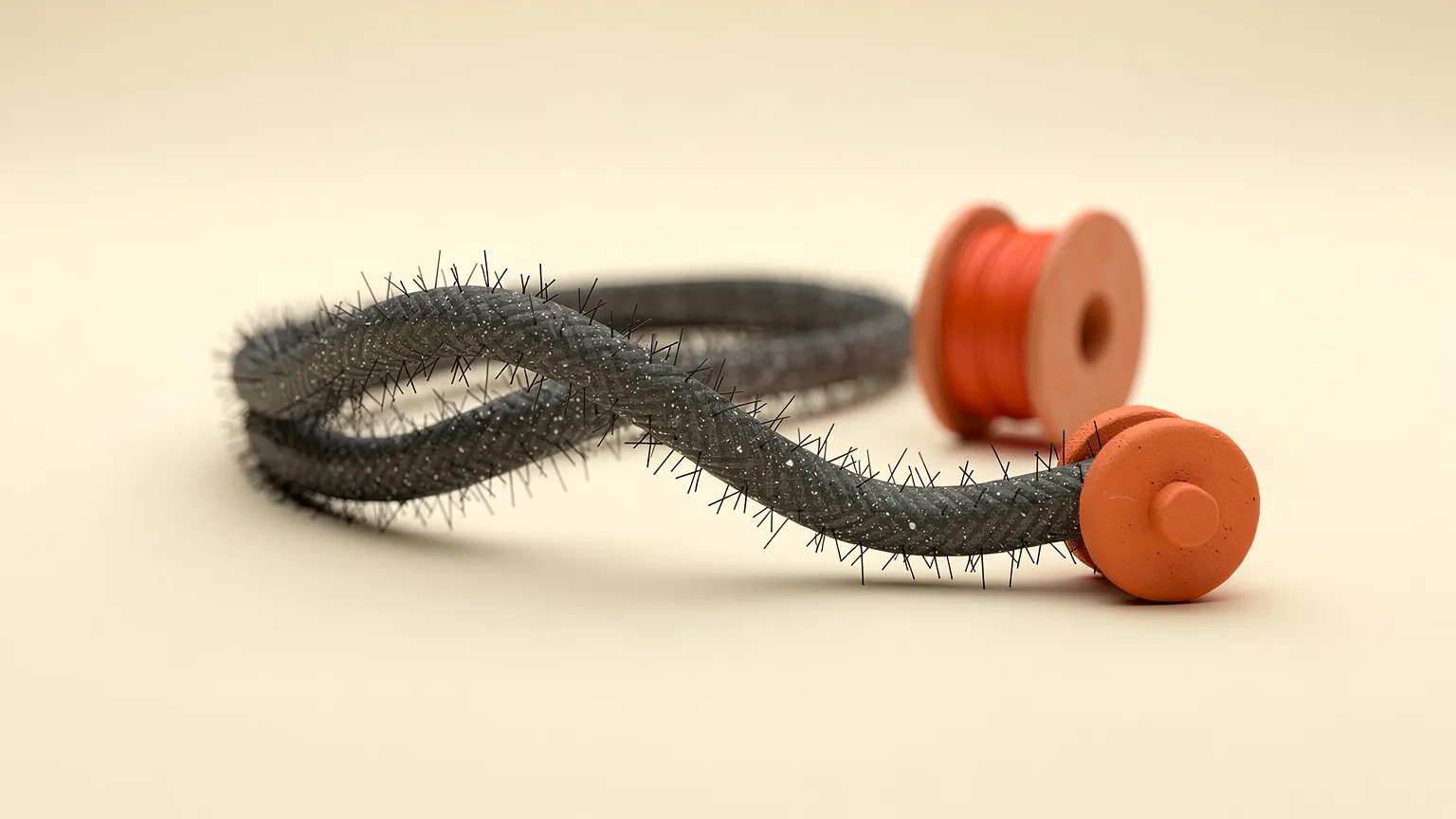
PETG-CF is PETG filament filled with chopped carbon fiber. It prints at PETG-like settings, gives parts a stiffer feel and a matte black finish, and wears out ordinary brass nozzles. This explainer uses maker data sheets and store pages. It is research only, and Nozzle Notes has not print-tested any PETG-CF spool.
What PETG-CF is
The "CF" stands for carbon fiber. Prusa describes its PETG Carbon Fiber as its classic Prusament PETG reinforced with carbon fiber, which improves some mechanical properties and adds an attractive look. Bambu Lab describes its PETG-CF as a carbon fiber reinforced PETG whose formulation minimizes the risk of warping and nozzle sticking, and Bambu's data sheet lists its composition as PETG and carbon fiber. For the base material, see what PETG is.
What the carbon fiber changes
Prusa says that compared with its regular PETG, the carbon fiber version has better dimensional stability, better temperature resistance, a higher modulus of elasticity and is less prone to stringing. It also lists the trade-offs: lower toughness than regular PETG, a hardened nozzle requirement, and that it is not suitable for small parts.
Prusa's general composite guide agrees on the pattern: fibers improve dimensional stability and high-temperature resistance, but the filament becomes more brittle, layer-to-layer adhesion gets worse and nozzle clogging becomes more likely.
PETG-CF vs PETG in maker data
Bambu Lab publishes data sheets for PETG-CF and for its PETG HF (a high-flow PETG). They are different products from the same maker, so this is an indication, not a controlled comparison. All values are Bambu's own typical figures.
| Bambu PETG HF | Bambu PETG-CF | |
|---|---|---|
| Nozzle temperature | 230 to 260 °C | 240 to 270 °C |
| Stiffness (Young's modulus, X-Y) | 1810 MPa | 2460 MPa |
| Tensile strength, across layers (Z) | 23 MPa | 29 MPa |
| Breaking elongation (X-Y) | 8.6% | 10.4% |
| Heat deflection (1.8 MPa) | 62 °C | 68 °C |
The CF version is stiffer and has a slightly higher heat deflection figure, which matches the direction of Prusa's claims. Bambu's figures also show a weakness that applies to most fiber-filled filaments: for PETG-CF, stiffness across the layers (1340 MPa) is far lower than along them (2460 MPa), so orient load-bearing parts with that in mind. For wider comparisons, read the filament comparison and our ABS vs PETG guide.
What your printer needs
- A hardened nozzle. Prusa says carbon, glass and kevlar fibers are abrasive and a hardened nozzle is necessary. Elegoo says the default nozzle is not recommended and asks for a hardened steel nozzle of 0.4 mm or larger. Bambu's data sheet lists 0.4, 0.6 and 0.8 mm nozzles for its PETG-CF. Prusa suggests that larger nozzles and thicker layers lower the chance of clogging. See nozzle sizes explained.
- A hotter nozzle than plain PETG. Bambu and Elegoo both list 240 to 270 °C, with a bed at 65 to 75 °C. Prusa lists 265 ±10 °C and a 90 ±10 °C bed for Prusament PETG Carbon Fiber. See the PETG print temperature guide for the basics.
- Dry filament. Bambu lists 65 °C for 8 hours in a blast drying oven and Elegoo asks for 60 °C for 8 hours before use. PETG-CF still absorbs moisture, so store it sealed. See how to dry filament.
- Good first layers. Prusa warns that a poor first layer risks clogging the nozzle when printing composites. Work through fixing a bad first layer first.
When to choose PETG-CF
- Choose it for stiff, dimensionally stable parts such as brackets, jigs, drone frames or enclosures where a matte black finish helps and the part is not tiny.
- Skip it for small detailed parts, for parts that need to absorb impacts (Prusa notes lower toughness than plain PETG), and for printers with a standard brass nozzle you do not want to replace.
Prusa lists the highly attractive matte black surface among the strengths of its version. For sanding dust and other handling questions, follow the manufacturer's Safety Data Sheet for your spool.
Cost
PETG-CF costs more than plain PETG, plus the cost of a hardened nozzle. On Elegoo's US store on 2026-10-10, its PETG-CF was listed at 18.99 USD for a 1 kg spool and its PETG Pro at 13.99 USD. Prices vary by brand, so check the current listing and use the print cost calculator to see what it adds to a part.
Short version. PETG-CF is a stiffer, more heat-tolerant, less stringy PETG that needs a hardened nozzle and gives up some toughness. It suits rigid functional parts more than impact-prone ones.
Frequently asked questions
What does CF mean in filament?
CF means carbon fiber. The filament is a base plastic such as PETG, PLA or nylon with short carbon fibers mixed in to change its stiffness, stability and appearance.
Do I need a hardened nozzle for PETG-CF?
Yes. Prusa says carbon fibers are highly abrasive and a hardened nozzle is necessary. Elegoo says the default nozzle is not recommended for its PETG-CF and asks for a hardened steel nozzle of at least 0.4 mm.
Is PETG-CF stronger than PETG?
It is stiffer and more dimensionally stable, but not tougher. Prusa lists lower toughness than regular PETG as a drawback, and its composite guide notes worse layer-to-layer adhesion. Choose it for rigid parts, not for impact resistance.
What temperature do you print PETG-CF at?
Bambu Lab and Elegoo list 240 to 270 °C at the nozzle and 65 to 75 °C at the bed. Prusa lists 265 ±10 °C and 90 ±10 °C for Prusament PETG Carbon Fiber. Use the range printed on your spool.
Does PETG-CF need to be dried?
Yes, it still absorbs moisture. Bambu lists 65 °C for 8 hours in a blast drying oven and Elegoo says to dry at 60 °C for 8 hours before use. Store it sealed with desiccant.
Sources

Founder and editor
Software engineer since 2009 and Head of Engineering by day, a maker who has owned several 3D printers, writing practical guides to 3D printers, filament and running costs, with every article saying what was and was not tested.
Keep reading
How Much Does 3D Printer Filament Cost?
PLA typically costs $14 to $20 per kilogram from mainstream makers, with engineering filaments several times higher. Dated store prices, cost per gram and ways to spend less.
10 October 2026 · 7 min read
PETG Print Temperature: Nozzle and Bed Settings
Prusa recommends 240 degrees C at the nozzle and 85 to 90 on the bed for PETG; Polymaker lists 240 to 260 and 60 to 70. Settings, cooling and tuning steps.
10 October 2026 · 5 min read
Nylon Filament for 3D Printing: What It Is and What It Needs
Nylon is tough, slippery and heat tolerant, but it needs a hot nozzle, a dry spool and usually an enclosure. Here is what it is, what it costs and what it asks of your printer.
10 October 2026 · 6 min read