What Is PETG? Properties, Uses and Print Settings
PETG is a tough, low-warping filament that prints hotter than PLA. Learn what it is, its properties, typical print settings, common problems and when to use it.
By Sepehr Sabbagh-pour · Published 10 October 2026 · 6 min read
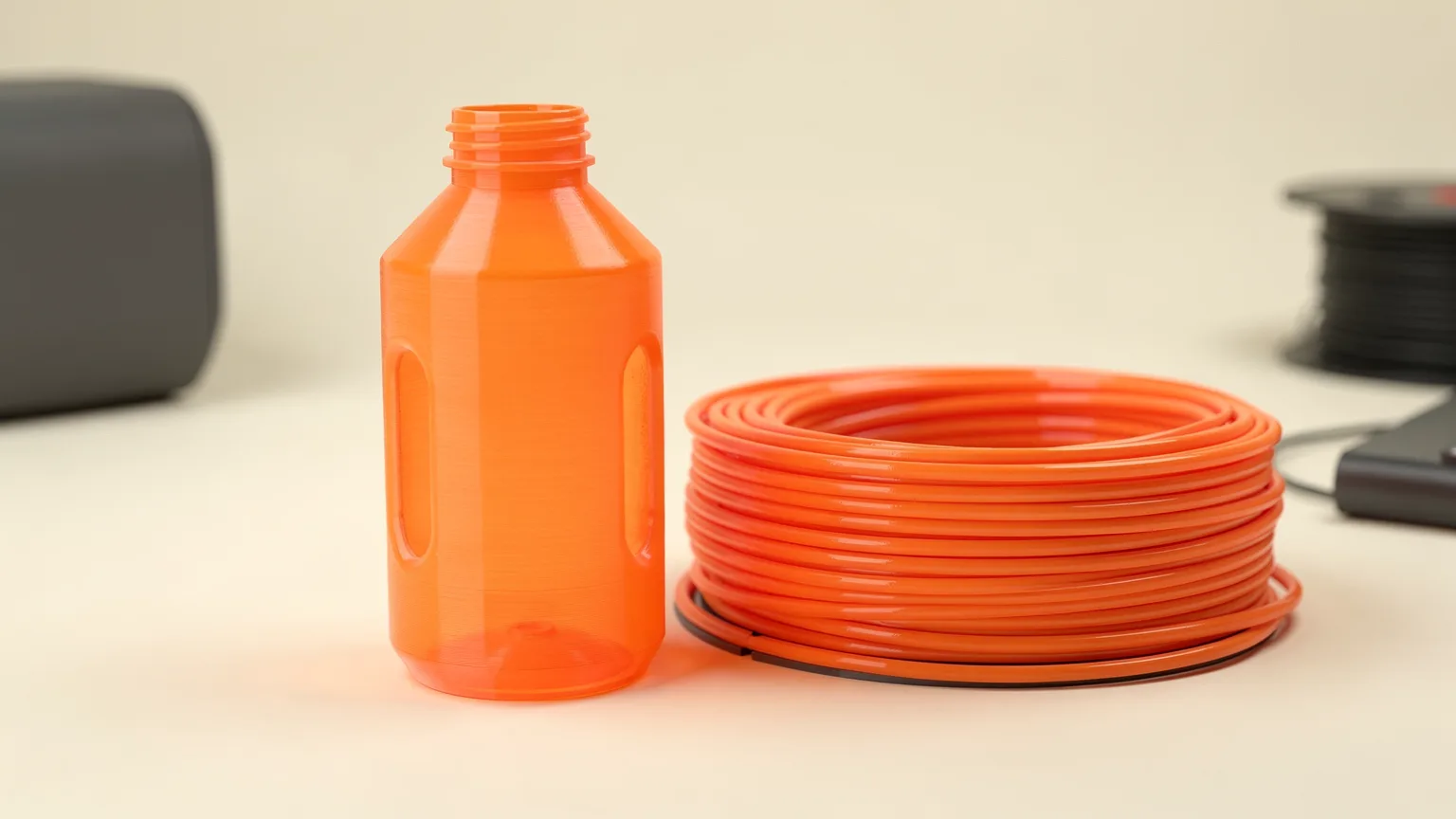
PETG is a tough, low-warping 3D printing filament that sits between PLA and ABS. It prints at higher temperatures than PLA, handles more heat and impact, and does not need an enclosure. This explainer covers what the name means, typical properties, print settings from Prusa's documentation, common problems and when to choose it. It is research from manufacturer pages, not our own print tests.
What PETG stands for
PETG is polyethylene terephthalate modified with glycol, which is where the G comes from. PET is the plastic used for drinks bottles. Prusa says the glycol makes it less brittle, easier to print and more transparent in translucent colors. Prusa also notes that unmodified PET is challenging to print and offers no advantage.
PETG properties at a glance
The figures below come from Prusa's PETG guide and its Prusament PETG product page, and they do not all agree, which is common between brands.
| Property | What the maker says |
|---|---|
| Nozzle temperature | Prusa KB: 230 °C first layer, 240 °C other layers. Prusament PETG page: 250 ± 10 °C |
| Bed temperature | Prusa KB: 85 °C first layer, 90 °C other layers. Prusament PETG page: 80 ± 10 °C |
| Heat resistance | Prusa KB: suitable for use below 80 °C. Prusament PETG page: 68 °C |
| Warping | Very little; Prusa says it suits large models |
| Toughness | High; ductile with a healthy amount of flex |
| Enclosure | Not required (Prusament PETG page) |
| Part cooling fan | Required; 50% fan speed listed on the Prusament page |
| Odor | Prusament lists it as odorless while printing |
Because the sources differ, treat the temperature printed on your own spool as the starting point. Prusa's own slicer comments show users noticing the same gap between its article and its slicer presets, so expect to adjust within the ranges.
Strengths of PETG
- Toughness. It flexes before it breaks, which is why it suits clips, holders and brackets. Compare it with PLA, which Prusa describes as brittle and prone to snapping along layers.
- Layer adhesion. Prusa credits good layer bonding for its use in waterproof parts.
- Low warping. Low thermal expansion means large prints rarely lift without an enclosure.
- Water and humidity resistance, and use outdoors in temperatures below 80 °C, according to Prusa's guide.
- Easy sanding, wet or dry.
Weaknesses and common problems
- Stringing. PETG tends to ooze. Prusa suggests more retraction and a lower nozzle temperature. See how to fix PETG stringing.
- Bridging and overhangs. Prusa lists poor bridging and overhangs, and supports that are harder to remove.
- Strong bed bonding. Prusa says not to print PETG on a smooth PEI sheet because the adhesion may be too strong and can damage the sheet. Use a powder-coated sheet, or apply a glue stick to the smooth sheet first.
- Fine detail. Prusa's pros and cons list says it is not great for detailed parts, and Prusament lists it as not suitable for tiny parts.
- Scratches more easily than PLA, according to Prusament.
- No acetone smoothing. Prusa says smoothing PETG chemically is only possible in a lab using dangerous chemicals.
Print settings to start from
- Nozzle and bed. Begin with the values on your spool. Prusa's guide gives 230 to 240 °C for the nozzle and 85 to 90 °C for the bed.
- Cooling. Prusa recommends cooling PETG to keep detail and prevent stringing. It suggests the fan off for the first few layers, then about half power. For maximum toughness it says to try turning the fan off, because hotter layers merge better.
- Print surface. Keep the surface clean and use a textured or powder-coated sheet.
- Stronger parts. Prusa advises adding perimeters rather than more infill.
- Moisture. Bambu Lab says damp filament causes stringing, oozing, holes and rough surfaces. Keep spools sealed or dry them first.
For temperature ranges across brands, see our page on PETG print temperature.
Food contact
Prusa says PETG itself may be considered food-safe, but it does not recommend any filament for dishes or other items that touch food, because bacteria can grow in the tiny grooves between layers. If you do print something for food use, Prusa suggests a food-safe coating and a clean steel nozzle. Follow your filament maker's guidance for the specific product.
Price
On the Prusament PETG page, checked on 2026-10-10 and showing US dollars, single colors were listed at 29.99 USD and 2 kg spools at 49.99 USD. Prices vary by brand, region and shipping, so check the current listing before you buy.
When to choose PETG
Choose PETG for functional parts that need to survive handling, moisture or moderate heat: brackets, enclosures, garden items and workshop holders. Choose PLA for display models and quick prototypes. Choose ABS or ASA when you need more heat resistance and have an enclosure. These comparisons are covered in PETG vs PLA, ABS vs PETG and PLA vs PETG vs ABS vs TPU. If you want extra stiffness, read about carbon fiber PETG.
Short version. PETG is the practical middle option: tougher and more weather-tolerant than PLA, easier to print than ABS. The price is stringing, poor overhangs and a bed that can grip too hard.
Frequently asked questions
What does PETG stand for?
PETG stands for polyethylene terephthalate modified with glycol. The glycol makes the plastic less brittle, easier to print and clearer in translucent colors.
Do I need an enclosure for PETG?
No. Prusament lists an enclosure as not required for PETG, and Prusa says its low thermal expansion means it rarely lifts from the bed even on large prints.
What temperature does PETG print at?
Prusa's knowledge base gives 230 to 240 °C for the nozzle and 85 to 90 °C for the bed. The Prusament PETG page lists 250 ± 10 °C and 80 ± 10 °C. Use the range printed on your own spool.
Is PETG food safe?
Prusa says PETG itself may be considered food-safe, but it advises against printing dishes or anything with direct food contact because bacteria can grow in the layer grooves. Follow your filament maker's guidance.
Sources

Founder and editor
Software engineer since 2009 and Head of Engineering by day, a maker who has owned several 3D printers, writing practical guides to 3D printers, filament and running costs, with every article saying what was and was not tested.
Keep reading
PLA vs PETG vs ABS vs TPU: Which Filament Should You Use?
Four materials cover most home printing. Here is what each is good at, what it demands from your printer, and how to choose without overthinking it.
10 October 2026 · 2 min read
0.2, 0.4 or 0.6 mm? What Nozzle Size Actually Changes
The standard 0.4 mm nozzle is a good all-rounder, but swapping size trades detail for speed and strength. Here is what changes and what to watch for.
10 October 2026 · 2 min read
ABS vs PETG: Which Should You Print With?
ABS and PETG are both tougher than PLA. PETG prints easily on open printers; ABS needs an enclosure but can be smoothed with acetone. Here is how to choose.
10 October 2026 · 7 min read