Nylon Filament for 3D Printing: What It Is and What It Needs
Nylon is tough, slippery and heat tolerant, but it needs a hot nozzle, a dry spool and usually an enclosure. Here is what it is, what it costs and what it asks of your printer.
By Sepehr Sabbagh-pour · Published 10 October 2026 · 6 min read
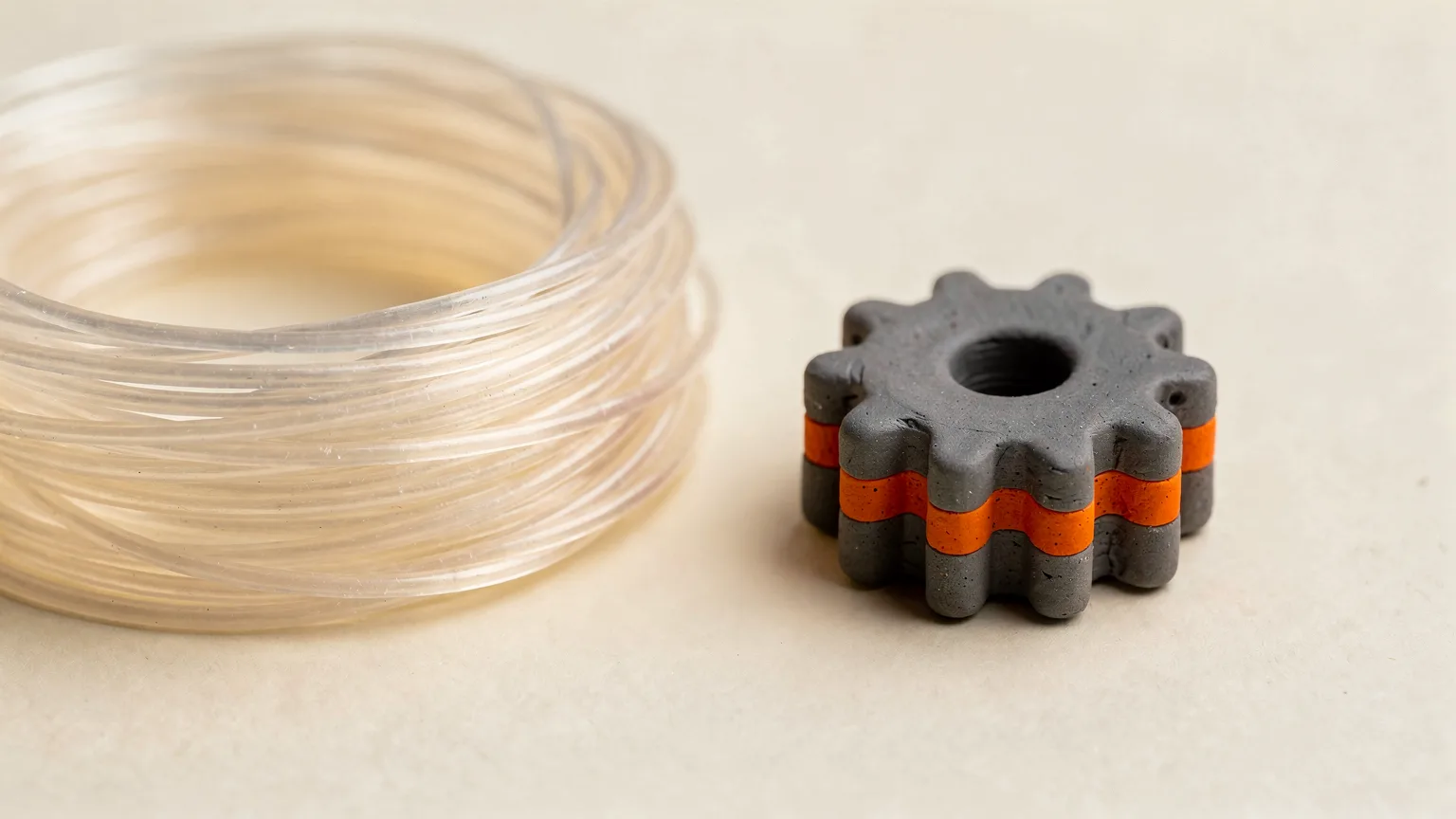
Nylon is a tough, slippery, heat-tolerant engineering plastic that is also one of the harder filaments to print. It is sold as nylon or by its chemical name, polyamide (PA). This guide explains what it is good for, what a printer needs before it can run it, and why wet filament is the main thing that goes wrong. It is built from manufacturer documentation and has not been print-tested by Nozzle Notes.
What nylon filament is
Nylon is a family of polyamide plastics. Prusa's materials guide describes polyamide as a material with excellent thermal and mechanical resistance, suited to functional technical parts that must withstand heat and mechanical load. Prusa also rates it as very hard to print and recommends it for experienced users only.
Prusa lists these strengths: it is extremely resilient and resistant to abrasion, it has excellent layer adhesion, it is tough in large volumes while staying flexible in thin sections, its friction coefficient is low and its melting temperature is high. Those traits explain why nylon is chosen for gears, bushings and bendable parts.
Typical print settings
The figures below are Prusa's recommendations for pure polyamide and Elegoo's listing for a carbon fiber nylon. Your spool and printer profile take priority, and these are starting points, not tested values.
| Pure polyamide (Prusa) | Carbon fiber nylon (Elegoo PAHT-CF) | |
|---|---|---|
| Nozzle temperature | 285 °C | 260 to 290 °C |
| Bed temperature | 110 °C | 90 to 110 °C |
| Drying before use | At least 4 hours, below 90 °C | 80 °C for 8 hours |
| Enclosure | High ambient temperature helps a lot | Listed as required |
| Nozzle | Standard | Hardened steel recommended |
For comparison, Prusa's PLA guide recommends 210 to 215 °C at the nozzle and a 60 °C bed. Nylon asks for a far hotter nozzle and bed, so check that your hotend and bed can reach those temperatures before buying a spool. Our PLA vs PETG vs ABS vs TPU guide shows where common filaments sit on that scale.
Why moisture is the main problem
Polyamide is hygroscopic, meaning it pulls water out of the air. Prusa says improper storage can let it absorb water weighing up to 10% of the filament's weight. In its drying guide, Prusa notes that polyamide is affected quite significantly, while PLA does not change much by taking up humidity.
Wet nylon shows up as bubbles, uneven layers and an ugly surface. Prusa's drying guide lists polyamide, PVA and TPU as the filaments most often in need of drying. Its advice is to keep highly hygroscopic filaments in a dry environment or dry them before every print.
- Dry before printing. Prusa suggests at least 4 hours below 90 °C. Check that your spool and dryer can handle the heat: Prusa says its newer black Prusament spools resist drying temperatures as high as 90 °C, and older spools may need preparation.
- Store airtight with desiccant. See how to store filament and how to dry filament.
- Consider a dryer that can print from the box. Our filament dryer guide covers what to look for.
Warping and bed adhesion
Prusa calls warping the main disadvantage of pure polyamide, apart from moisture. An enclosure that holds a high ambient temperature helps a lot. Our guide to enclosed vs open-frame printers explains why that matters.
Adhesion is a second hurdle. Prusa sells a special PA sheet because polyamide adheres poorly to standard PEI sheets. Whatever printer you own, look for a bed surface or adhesive that the maker recommends for nylon.
Carbon fiber and glass fiber nylon
Many nylon products are filled with fibers. Prusa says its fiber-filled polyamide, such as Prusament PA11 Carbon Fiber, does not warp nearly as much as the unaltered versions and can be printed without an enclosure. Fibers generally improve dimensional stability and high-temperature resistance, but Prusa's composite guide also lists drawbacks: a more brittle filament, worse layer-to-layer adhesion and a higher risk of nozzle clogging.
Fibers are abrasive. Prusa says a hardened nozzle is necessary, and Elegoo recommends a hardened steel nozzle for its nylon carbon fiber product. Brass nozzles wear quickly with these filaments. Our nozzle size guide covers sizes, and Prusa's composite guide says larger nozzles and thicker layers reduce clogging risk.
Cost
Nylon costs several times more than basic PLA. On Elegoo's US store on 2026-10-10, PAHT-CF carbon fiber nylon was listed at 55.99 USD for a 1 kg spool, while its standard PLA was 13.99 USD. Other makers price differently, so check the current listing.
Safety
Prusa says polyamides emit a strong odor with potentially dangerous ultrafine particles, and that printing in a well-ventilated room or an enclosure is a must. Follow the filament maker's guidance and the Safety Data Sheet for your specific spool. This article is not medical or safety advice.
Is nylon right for your project?
Quick rule. Choose nylon only when a part must resist wear, flex repeatedly or tolerate heat, and only if your printer can reach the temperatures and you can keep the filament dry. For most brackets and enclosures, PETG is far easier to print.
If you are still choosing a machine, start with the first printer checklist, and use the print cost calculator to see what an expensive spool does to the price of a part.
Frequently asked questions
What is nylon filament used for?
Prusa recommends polyamide for technical parts that need good heat, chemical and mechanical resistance. Gears, bushings and bendable parts are typical examples because nylon resists abrasion and has a low friction coefficient.
Is nylon hard to print?
Yes. Prusa calls pure polyamide very hard to print and recommends it for experienced users only. The main problems are moisture, warping and poor adhesion to standard PEI sheets.
Do I need an enclosure to print nylon?
For pure polyamide, Prusa says a high ambient temperature from an enclosure helps a lot with warping. Fiber-filled nylon warps much less and Prusa says its carbon fiber polyamide can be printed without an enclosure, but Elegoo lists an enclosed printer as required for its PAHT-CF, so follow the maker of your spool.
How do I dry nylon filament?
Prusa suggests drying polyamide for at least 4 hours at a temperature below 90 °C. Elegoo lists 80 °C for 8 hours for its carbon fiber nylon. Use a filament dryer or oven that stays at an even temperature, and check your spool can take the heat.
Do I need a hardened nozzle for nylon?
Not for pure nylon, but yes for carbon fiber or glass fiber filled versions. Prusa says carbon, glass and kevlar fibers are abrasive and require a hardened nozzle.
Sources

Founder and editor
Software engineer since 2009 and Head of Engineering by day, a maker who has owned several 3D printers, writing practical guides to 3D printers, filament and running costs, with every article saying what was and was not tested.
Keep reading
How Much Does 3D Printer Filament Cost?
PLA typically costs $14 to $20 per kilogram from mainstream makers, with engineering filaments several times higher. Dated store prices, cost per gram and ways to spend less.
10 October 2026 · 7 min read
PETG Print Temperature: Nozzle and Bed Settings
Prusa recommends 240 degrees C at the nozzle and 85 to 90 on the bed for PETG; Polymaker lists 240 to 260 and 60 to 70. Settings, cooling and tuning steps.
10 October 2026 · 5 min read
What Is PETG-CF? Carbon Fiber Filament Explained
PETG-CF is PETG filled with carbon fiber: stiffer, more stable and less stringy, but less tough and abrasive on nozzles. Here is what it needs and when it is worth it.
10 October 2026 · 6 min read