Cheap vs Premium Filament: What Actually Differs
Premium PLA can cost roughly double budget PLA, yet the stated tolerance is often the same. What the extra money buys when you compare cheap vs expensive filament.
By Sepehr Sabbagh-pour · Published 10 October 2026 · 7 min read
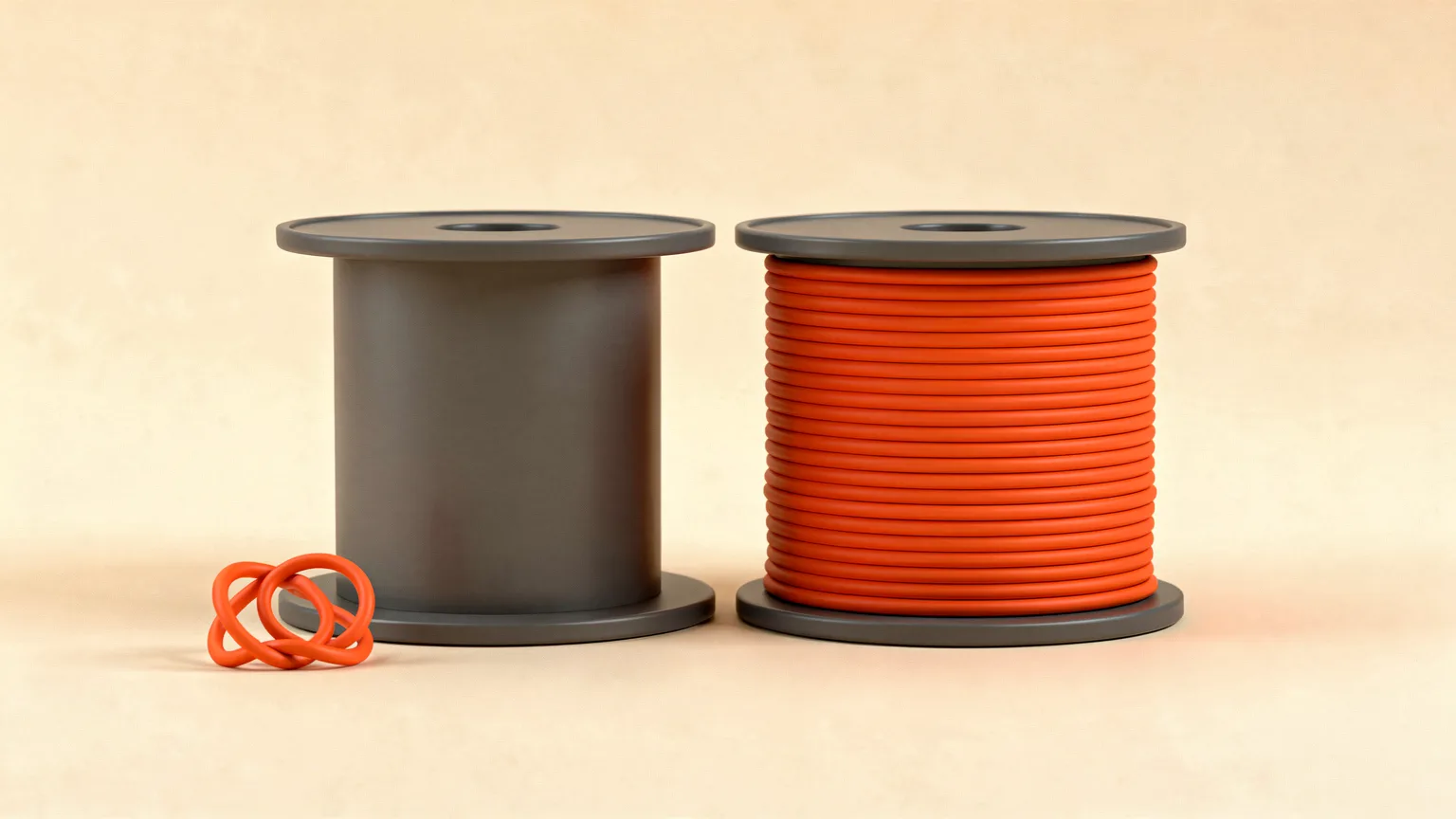
Premium filament costs roughly double budget filament, and the difference is rarely visible in a spec table. This guide compares what makers actually state: tolerance, quality-control data, spool design, color consistency, material range and price. It is built from maker pages, not from printing both side by side, so it explains what to look for rather than declaring a winner.
This is a research article. We have not tested these filaments. Prices were checked on 2026-10-10 on the store pages listed in the sources, and each names its store region.
Who should buy which
- Choose budget filament for everyday PLA: prototypes, figures, jigs and anything you may reprint. The savings add up fast on a busy printer.
- Choose premium filament when a failed print is costly, when you need to match colors across several spools, or when you want published batch data.
- Choose mid-priced mainstream brands if you want an AMS-friendly spool and solid reputation without paying the top price.
The price gap
| Filament | Store region | Price, 1 kg (2026-10-10) |
|---|---|---|
| Elegoo PLA | US store | $13.99 |
| Elegoo PLA Plus | US store | $14.99 |
| Polymaker PolyLite PLA | US store | $19.99 |
| Bambu Lab PLA Basic, with spool | UK store | £16.99 |
| Prusament PLA | Prusa store, UK pricing | £29.99 |
The two ends of this list differ by roughly 2 to 1 once you ignore currency: £29.99 for Prusament PLA against £13.99 for Bambu Lab's refill, and $19.99 for PolyLite PLA against $13.99 for Elegoo PLA. On a 100 g print the difference is under a pound or a dollar or two. Over ten spools it is real money. For more prices and per-print arithmetic, see how much filament costs.
What makers claim, side by side
| Elegoo PLA | Bambu Lab PLA Basic | Prusament PLA | |
|---|---|---|---|
| Diameter tolerance | ±0.02 mm | ±0.03 mm | ±0.02 mm |
| Published per-spool data | Not stated on the product page | Not stated on the product page | Prusa says each spool comes with measured diameter, weight and ovality data |
| Color consistency claim | Not stated | Not stated | Prusa says each color is formulated and checked so reorders match |
| Spool and AMS notes | Not covered here | Spool or refill; all AMS series compatible | New black spool resists drying up to 90 °C |
| Price (1 kg) | $13.99 | £16.99 (£13.99 refill) | £29.99 |
These are the makers' own statements, not measurements. The cheapest spool and the dearest one list the same tolerance, and the middle one lists a looser one. So the tolerance number alone is a poor guide to price or quality. What differs is evidence: Prusa publishes measured data for each spool, which lets you check a claim, while the other pages state a figure without that record.
What you pay for in a premium spool
Verification, not just a number
Prusa's product page says it measures and records diameter and ovality along the full length of every spool and publishes the data, and that this is what separates its precision claim from marketing. If that matters to you, it is a concrete benefit. If your printer handles normal variation, you may never notice.
Color matching
Premium makers promote consistent color between batches. This matters if you will reorder to finish a large project or print matching parts over months. For single-color hobby prints it matters little.
Spool and winding
Tangles, slipping spools and loose winding cause failed prints. Prusa describes a locking, refillable spool that survives drying at higher temperatures. Bambu Lab describes plastic spools designed for the AMS, and its wiki warns that cardboard spools need adapters to reduce slippage. Polymaker says its spools have hardened edges that roll well in the AMS. These are features of the spool, and they do not always track price.
Range and support
Larger brands sell specialty materials, publish data sheets and print profiles, and have support teams. That matters more for engineering materials than for PLA.
What a cheap spool can cost you
- Wet filament. Packaging and storage matter for every brand. Damp filament causes stringing and weak layers regardless of price, which is why storage matters more than brand.
- Dimensional variation. A looser diameter can lead to uneven extrusion. The guides for under-extrusion and over-extrusion show the settings to check first, since the cause is often not the filament.
- Color drift between spools bought at different times.
- Feeding problems. Spool dimensions and winding quality can cause tangles in an AMS.
None of these is guaranteed with budget filament, and premium filament can still fail if stored badly. Check recent reviews for the exact product and color you want.
How to choose
- Match the material to the job before comparing brands. PETG vs PLA is the usual first decision.
- Buy a single budget spool first. If it feeds and prints cleanly with the maker's recommended temperatures, you have your answer without much risk.
- Look for the data. A stated tolerance, a spool label with temperature range, and drying guidance are signs of a documented product.
- Pay more where it counts. Engineering materials and long, valuable prints justify better filament more than a throwaway PLA model.
- Dry and store everything. See how to dry filament.
Frequently asked questions
Is expensive filament better than cheap filament?
Not automatically. Elegoo and Prusament both state a ±0.02 mm diameter tolerance despite a roughly 2 to 1 price gap. Premium filament mostly adds published quality data, color consistency and spool design.
How much more does premium filament cost?
On 2026-10-10 Prusament PLA was £29.99 per 1 kg at Prusa's store with UK pricing, Bambu Lab PLA Basic £16.99 with a spool at its UK store, and Elegoo PLA $13.99 at its US store.
Does filament tolerance matter?
Diameter tolerance affects how consistently plastic is extruded. The stated figure is a manufacturer claim, and Prusa says it publishes measured data per spool so buyers can verify it. Check the maker's own statement.
Is it worth buying cheap filament for beginners?
For everyday PLA, many people start with a budget spool, then step up only if they see feeding or consistency problems. Store it dry whichever brand you pick, because moisture ruins prints at any price.
Why does filament quality vary between brands?
Brands differ in material formulation, quality control, packaging, spool design and color matching. These are documented partly in maker pages. Always read recent reviews of the exact color and material before buying.
Sources

Founder and editor
Software engineer since 2009 and Head of Engineering by day, a maker who has owned several 3D printers, writing practical guides to 3D printers, filament and running costs, with every article saying what was and was not tested.
Keep reading
PLA vs PETG vs ABS vs TPU: Which Filament Should You Use?
Four materials cover most home printing. Here is what each is good at, what it demands from your printer, and how to choose without overthinking it.
10 October 2026 · 2 min read
0.2, 0.4 or 0.6 mm? What Nozzle Size Actually Changes
The standard 0.4 mm nozzle is a good all-rounder, but swapping size trades detail for speed and strength. Here is what changes and what to watch for.
10 October 2026 · 2 min read
ABS vs PETG: Which Should You Print With?
ABS and PETG are both tougher than PLA. PETG prints easily on open printers; ABS needs an enclosure but can be smoothed with acetone. Here is how to choose.
10 October 2026 · 7 min read