How Long Does a Spool of Filament Last?
A 1 kg spool holds about 349 meters of 1.75 mm PLA. Here is how to turn slicer weights into prints per spool, estimate how long it lasts, and what makes it run out faster.
By Sepehr Sabbagh-pour · Published 12 October 2026 · 6 min read
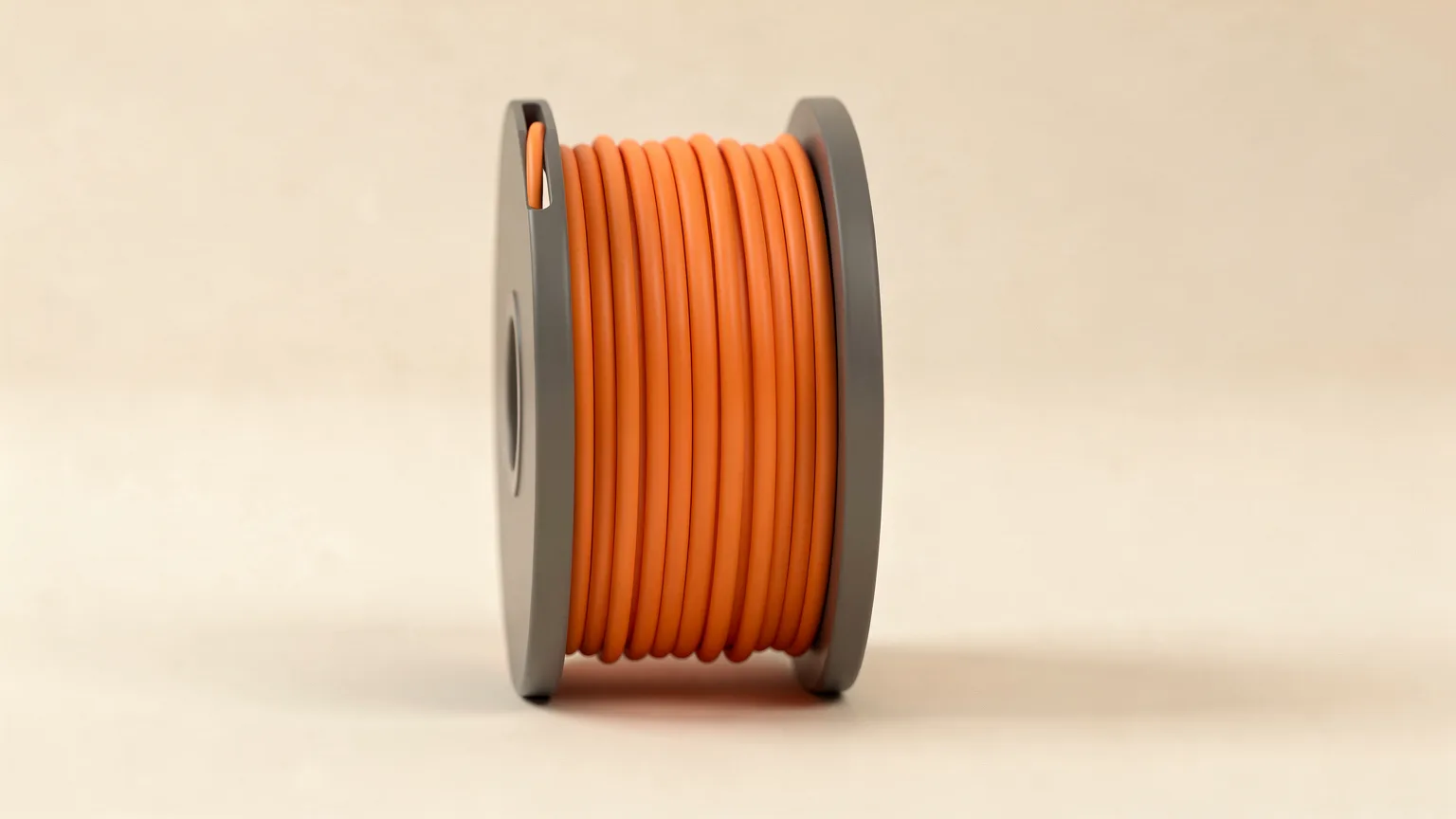
A 1 kg spool of 1.75 mm PLA holds roughly 350 meters of filament, and how long that lasts depends entirely on what you print. A small figure might use 10 g, a bracket 40 g, a large functional part several hundred grams. This guide shows how to turn a slicer estimate into spools and print hours, so you can predict how often you will reorder.
This is a research article. The length figures are arithmetic from a density value published by Polymaker, and the usage examples are illustrative scenarios, not measurements. Your own numbers will differ.
The short answer
- A 1 kg spool is 1,000 g of plastic, so it covers twenty 50 g prints or ten 100 g prints.
- With 1.75 mm PLA at a density of 1.19 g/cm³, 1 kg is about 349 meters of filament.
- Time on the printer matters less than weight. A fast, hollow print can take hours and use little plastic, while a small solid part can use a lot.
- Filament left on a printer is not used up by time alone, but moisture can make it unusable before the plastic runs out. See does filament expire.
How much filament is on a spool?
Spools are sold by weight, not length. Polymaker lists its PolyLite PLA with a density of 1.19 g/cm³ and sells it in 1 kg, 3 kg and 5 kg spools at 1.75 mm and 2.85 mm diameters. Length follows from weight, density and the cross-section of the filament:
| Filament | Cross-section | Length in 1 kg (density 1.19 g/cm³) |
|---|---|---|
| 1.75 mm | 2.41 mm² | about 349 m |
| 2.85 mm | 6.38 mm² | about 132 m |
The cross-section is the area of a circle with the filament's diameter. Other materials have different densities, so a kilogram of a denser material is a shorter length, and a lighter material is longer. Check the density on the maker's data sheet if you need the exact length. Spool weight also usually refers to filament only, not the empty spool. Our diameter guide explains why 1.75 mm is the common size.
How many prints does a spool give you?
Divide 1,000 g by the weight of your typical print. Slicers show the estimated filament weight for a job on the preview screen, and that number includes walls, infill, supports, brim and any purge material for color changes. Illustrative arithmetic:
| Print weight | Prints per 1 kg spool |
|---|---|
| 10 g (small figure) | 100 |
| 25 g | 40 |
| 50 g | 20 |
| 100 g | 10 |
| 250 g (large functional part) | 4 |
Failed prints, test prints and calibration cubes use filament too. If you print often while learning, expect to go through your first few spools faster than the weight of your finished prints suggests. Fixing common faults early saves plastic: bad first layer and stringing are good places to start.
How long does a spool last in time?
There is no single figure, because the filament flow rate depends on layer height, line width, speed and nozzle size. As a rough illustration, if a printer ran for 10 hours a week and averaged 20 g of filament per hour, a 1 kg spool would last 5 weeks. If it averaged 8 g per hour, the same spool would last 12.5 weeks. Treat these as examples of the method: weigh a few of your own prints, note the print time from the slicer, and divide.
A larger nozzle pushes more plastic per hour. A 0.4 mm nozzle is the usual default, and wider nozzles raise throughput, which is covered in nozzle sizes explained.
What makes a spool run out faster
- High infill and many walls. Strong parts use more plastic. Lowering infill saves filament, but only do it on parts that do not carry load.
- Supports, brims and rafts. These are printed and thrown away.
- Multi-color purging. Systems that swap filaments mid-print purge old color into a waste tower or chute. Bambu Lab's wiki has dedicated pages on reducing waste during filament changes and handling purged filament.
- Failed prints and test pieces. Especially in the first weeks with a new printer.
- Heavier materials. A denser filament weighs more for the same volume, so a given print costs more grams.
When a spool is nearly empty
Many printers can pause when a spool runs out, and some can switch to another spool of the same type. Whether yours does depends on the model, so check its manual. If a print will use more plastic than remains, the slicer's weight estimate tells you before you start. Start the print on a fresh spool if the estimate is close to what is left.
Keeping a spool usable to the end
A spool that lasts months needs proper storage. Bambu Lab's wiki says filament absorbs moisture from the air and that moisture vaporizes in the hot nozzle, causing stringing, bubbles and weaker prints. Both Bambu Lab and Prusa recommend sealed storage with desiccant. See how to store filament and how to dry filament. To work out what each spool costs you, see how much filament costs and the print cost calculator.
Frequently asked questions
How many meters of filament are in a 1 kg spool?
About 349 meters for 1.75 mm PLA with a density of 1.19 g/cm3, as published by Polymaker for PolyLite PLA. For 2.85 mm filament the same weight is about 132 meters. Other materials have other densities.
How many prints can I get from one spool of filament?
Divide 1,000 g by the weight of each print. A 50 g print gives about 20 prints per spool, a 100 g print about 10. Your slicer shows the estimated weight for each job.
How many hours of printing is a 1 kg spool?
It depends on how fast your print settings push plastic. At an illustrative 20 g of filament per hour, 1 kg is 50 print hours, and at 8 g per hour it is 125 hours. Use your own slicer estimates.
Does filament run out faster with supports or color changes?
Yes. Supports, brims and rafts are printed and discarded, and multi-color systems purge filament during changes. Both add grams that the finished part does not contain.
Can I use a partly used spool for a long print?
Check the slicer's filament weight estimate against the plastic left on the spool. If it is close, start on a fresh spool, or use a printer feature that can switch to another spool of the same type if your model supports it.
Sources

Founder and editor
Software engineer since 2009 and Head of Engineering by day, a maker who has owned several 3D printers, writing practical guides to 3D printers, filament and running costs, with every article saying what was and was not tested.
Keep reading
How to Store Filament So It Stays Dry
Filament absorbs moisture from the air, and the best fix is storage that stops it. Sealed containers, desiccant and a hygrometer, plus which materials need the most care.
12 October 2026 · 5 min read
PLA Print Temperature: Nozzle and Bed Settings
Prusa recommends 210 to 215 degrees C at the nozzle and 60 on the bed for PLA; Polymaker gives 190 to 230. Here is how to pick a starting point and tune it.
11 October 2026 · 5 min read
What Is Silk PLA? How It Differs From Standard PLA
Silk PLA is a glossy, decorative PLA that is weaker and more brittle than the basic kind. Here is how it differs from standard PLA and what to print with it.
11 October 2026 · 6 min read