What Is Silk PLA? How It Differs From Standard PLA
Silk PLA is a glossy, decorative PLA that is weaker and more brittle than the basic kind. Here is how it differs from standard PLA and what to print with it.
By Sepehr Sabbagh-pour · Published 11 October 2026 · 6 min read
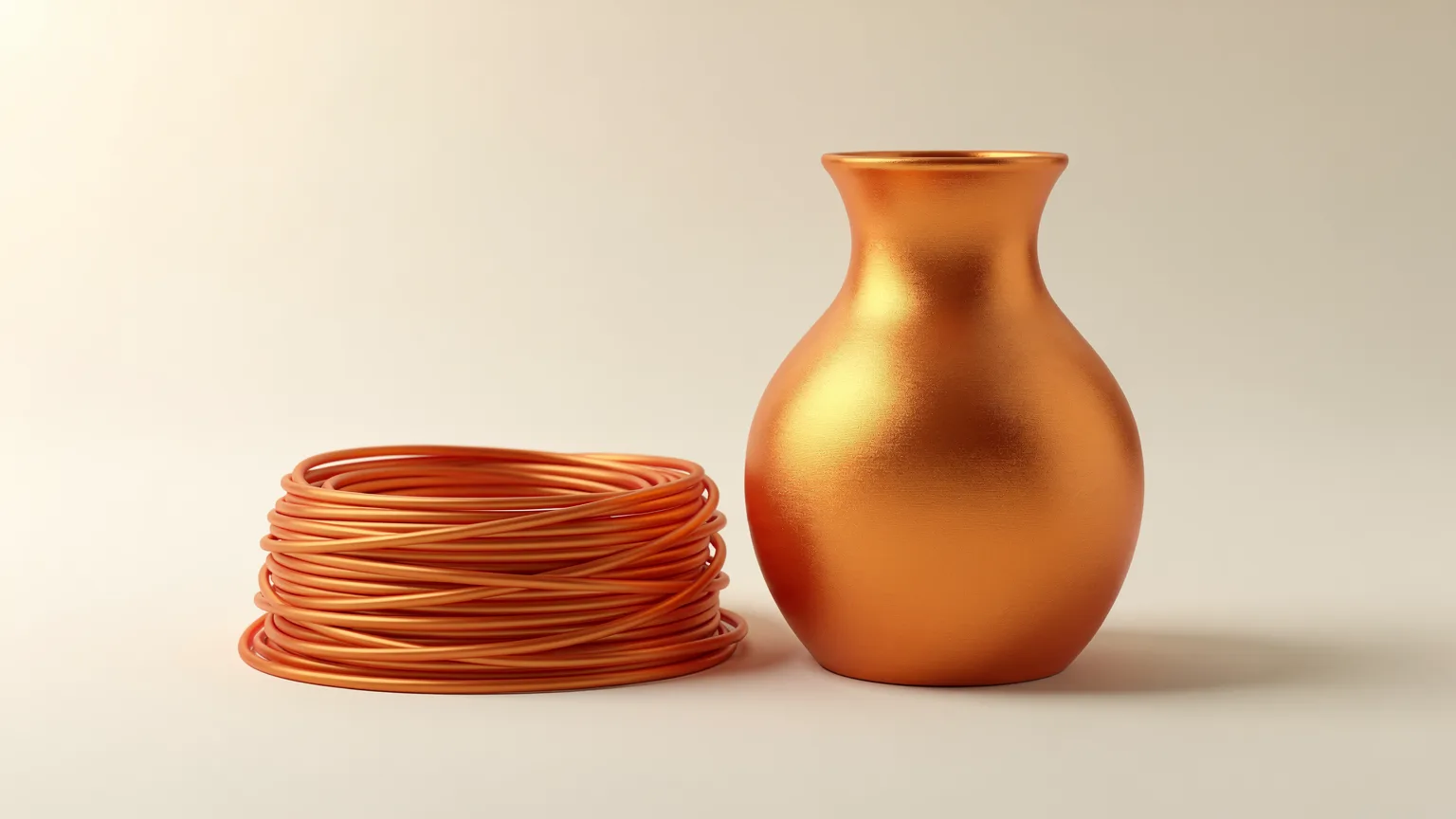
Silk PLA is a PLA filament formulated for a glossy, metallic or pearly shine. It prints on the same machines as ordinary PLA, but it is built for looks rather than strength. This explainer uses maker data sheets and store pages and has not been print-tested by Nozzle Notes.
What silk PLA is
Silk PLA is still polylactic acid. Bambu Lab's data sheet lists the composition of its PLA Silk as polylactic acid, and describes it as retaining a silky texture and high-gloss features, ideal for aesthetic parts and decorative objects. Elegoo describes its Silk PLA as made of PLA with a glossy surface finish. The shine comes from how the filament is formulated, so the finish is a property of the product, not of a different base plastic.
Several brands also sell dual-color or gradient versions, where two silk colors are blended into one strand. Bambu's dual-color silk is an example: it transitions between colors, and the visible color changes as you rotate the filament orientation.
Silk PLA vs standard PLA
The table compares Bambu Lab's published data sheets for PLA Silk (the dual-color version) and PLA Basic. They are the same maker's own figures, though each is a typical value for one product, and other brands will differ.
| Bambu PLA Basic | Bambu PLA Silk (dual-color) | |
|---|---|---|
| Nozzle temperature | 190 to 230 °C | 210 to 240 °C |
| Bed temperature | 35 to 45 °C | 35 to 45 °C |
| Maximum print speed | Under 300 mm/s | Under 250 mm/s |
| Tensile strength, along layers (X-Y) | 35 MPa | 27 MPa |
| Tensile strength, across layers (Z) | 31 MPa | 18 MPa |
| Breaking elongation (X-Y) | 12.2% | 3.5% |
| Heat deflection (1.8 MPa) | 54 °C | 50 °C |
The pattern is clear: the silk version is hotter to print, a little slower, weaker, especially between layers, and more brittle. Its heat deflection figure is no better than basic PLA. That fits Prusa's general description of PLA as unsuitable for technical use and a material that softens above 60 °C.
Where it works and where it does not
Polymaker's FAQ for its Panchroma Silk PLA says plainly that silk PLA is designed for aesthetics, not for high-load or mechanical parts, and suggests display models, props and low-wear designs. Typical uses it lists include home decor, cosplay props, sculptures, miniatures and gifts.
- Good fits: vases, figurines, trophies, ornaments, desk decor, lamp shades and gifts.
- Poor fits: clips, hinges, brackets, snap fits, tool holders, anything stressed along its layers, and anything that sits in a hot car or near a heater.
For parts that must take a load, move to a tougher material. See what PETG is and our comparison of PLA, PETG, ABS and TPU.
Print settings and tips
Settings come from the maker, so use the range on your own spool first.
- Temperature. Bambu lists 210 to 240 °C for its dual-color silk. Polymaker lists 190 to 230 °C for Panchroma Silk PLA with a 25 to 60 °C bed. Prusa's plain PLA guide uses 210 to 215 °C and a 60 °C bed. See the PLA print temperature guide for how temperature changes results.
- Cooling. Both Bambu and Polymaker say to keep the cooling fan on, and Polymaker advises full fan for the best surface quality.
- Speed. Maker limits vary: Bambu lists under 250 mm/s and Polymaker says Panchroma Silk can reach up to 250 mm/s, with its gloss maintained at speeds up to 150 mm/s. Polymaker also advises slower speeds on stock, older-style printers.
- Retraction. Bambu suggests 0.6 to 1.0 mm for its silk. Silk can string, so if you see hairs, work through the stringing fixes.
- Drying. Bambu lists 55 °C for 8 hours in a blast drying oven, and Polymaker says 55 °C for 6 hours only if it has absorbed moisture. See how to dry filament.
Polymaker also notes that older silk formulas had issues such as brittleness, clogging and loss of shine at higher speeds, and says its newer formula addresses them. That is a maker claim, so look for recent reviews of the exact product.
Cost
Silk usually costs more than basic PLA. On Elegoo's US store on 2026-10-10 its Silk PLA was listed at 18.99 USD per 1 kg spool, against 13.99 USD for its standard PLA, about 5 USD more. Check the current listing, as prices change.
If you only read one thing. Silk PLA is for things you look at, not things you load. Print the visible model in silk and use a tougher filament for any part that works.
New to filament choice? Start with the beginner guide and see how PLA+ differs from PLA.
Frequently asked questions
What is silk PLA?
Silk PLA is PLA formulated for a glossy, metallic or pearly shine. Bambu Lab lists the composition of its PLA Silk as polylactic acid and says it suits aesthetic parts and decorative objects.
Is silk PLA weaker than normal PLA?
According to Bambu Lab data sheets, yes. Its PLA Silk dual-color filament listed 27 MPa tensile strength along the layers and 18 MPa across them, against 35 and 31 MPa for PLA Basic. Other brands will differ, but silk is generally treated as a decorative material.
Does silk PLA need a higher temperature?
Often. Bambu lists 210 to 240 °C for its silk against 190 to 230 °C for PLA Basic. Polymaker lists 190 to 230 °C for Panchroma Silk PLA. Use the range printed on your spool and tune from there.
Can I use silk PLA for functional parts?
It is not recommended. Polymaker says silk PLA is designed for aesthetics and is not meant for high-load or mechanical parts. Use a tougher material for parts that bear loads.
Is silk PLA more expensive than regular PLA?
Usually. On Elegoo US on 2026-10-10 a 1 kg spool of Silk PLA was 18.99 USD against 13.99 USD for its standard PLA. Prices vary by brand and change over time.
Sources

Founder and editor
Software engineer since 2009 and Head of Engineering by day, a maker who has owned several 3D printers, writing practical guides to 3D printers, filament and running costs, with every article saying what was and was not tested.
Keep reading
What Is Wood Filament? Uses, Wear and Settings
Wood filament is usually PLA mixed with wood fibers for a matte, stainable finish. Here is what it is, what it wears, and the maker settings to start from.
11 October 2026 · 4 min read
How Much Does 3D Printer Filament Cost?
PLA typically costs $14 to $20 per kilogram from mainstream makers, with engineering filaments several times higher. Dated store prices, cost per gram and ways to spend less.
10 October 2026 · 7 min read
PETG Print Temperature: Nozzle and Bed Settings
Prusa recommends 240 degrees C at the nozzle and 85 to 90 on the bed for PETG; Polymaker lists 240 to 260 and 60 to 70. Settings, cooling and tuning steps.
10 October 2026 · 5 min read