What Is Wood Filament? Uses, Wear and Settings
Wood filament is usually PLA mixed with wood fibers for a matte, stainable finish. Here is what it is, what it wears, and the maker settings to start from.
By Sepehr Sabbagh-pour · Published 11 October 2026 · 4 min read
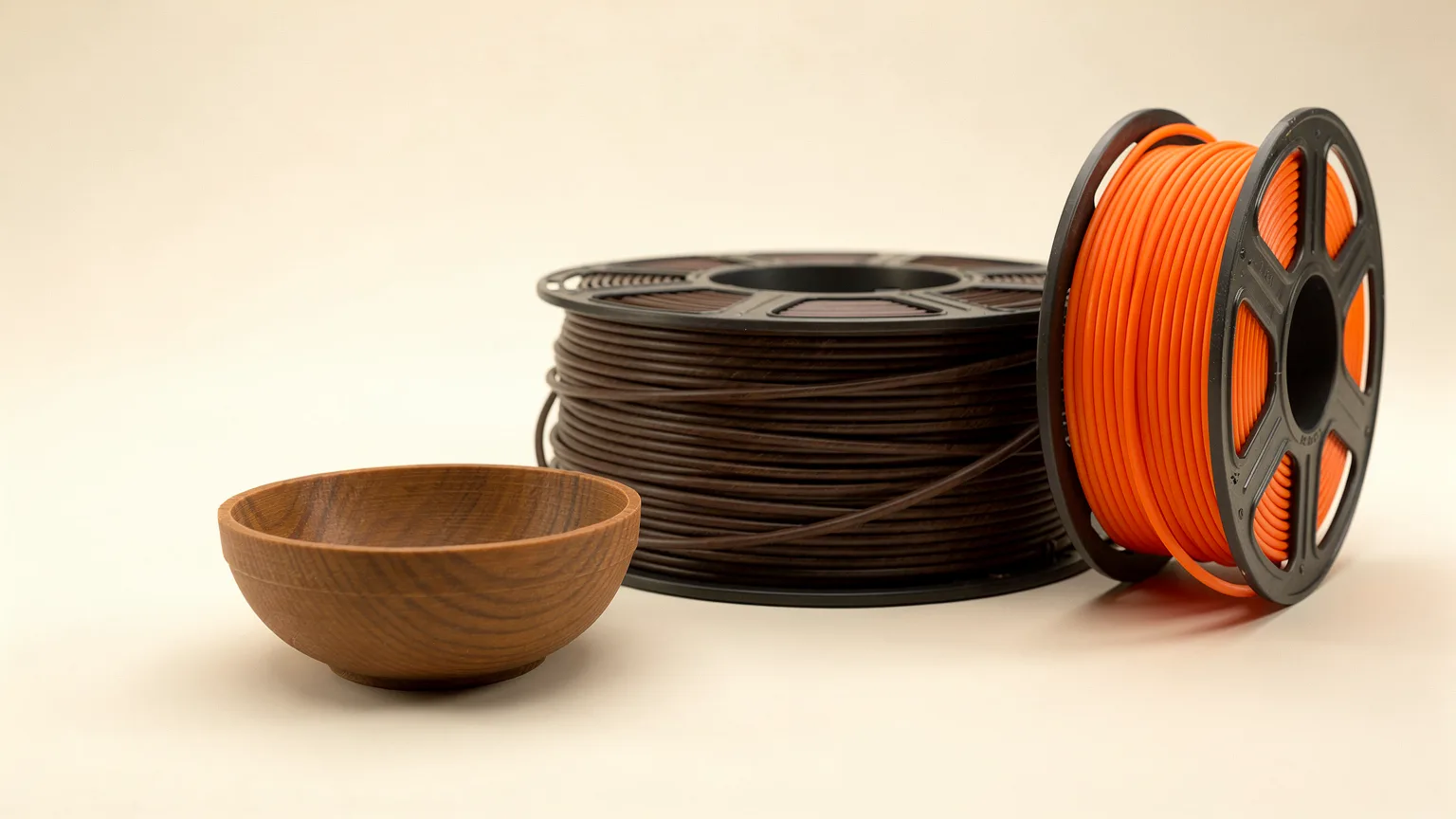
Wood filament is a 3D printing material that looks and smells a little like wood. Most spools are PLA mixed with fine wood fibers or powder, so the printed part has a matte, grainy surface that can be sanded and stained. This page is desk research from maker documentation, and the settings are starting points, not tested results.
What wood filament is made of
Prusa's knowledge base describes composite filaments filled with wood powder as usually PLA or PETG with wood added. Two maker examples show the range:
- colorFabb woodFill is listed as a PLA/PHA blend with fine pinewood fibers. The maker says it contains recycled wood fibers and remnants from another production process.
- Prusament Woodfill contains wood particles sourced from manufacturing waste, according to Prusa.
Not every "wood" spool contains wood. Polymaker's Wood PLA is described by the maker as a wood-look filament without actual wood powder. It is plain PLA with a foaming process that gives it a density of 0.8 g/cm3, and the maker says this removes the risk of nozzle clogs from wood particles. Read the product page before assuming which kind you are buying.
What it is good for
Wood filament suits decorative parts where the look matters more than strength: picture frames, plant pots, desk organizers, models, signs and props. Prusa notes it can be sanded and stained like real wood, which gives a weathered look. The color varies from batch to batch because the wood fibers vary. colorFabb says this directly on its product page.
It is a poor choice for load-bearing or hot environments. Prusa describes Prusament Woodfill as brittle with low heat resistance, and says wood-filled materials have worse mechanical resistance and layer adhesion than the unmodified plastic. colorFabb lists a glass transition temperature of 55°C for woodFill, so a part left in a hot car can soften.
Does wood filament wear out your nozzle?
The answer depends on the source. A general reference such as Wikipedia says brass nozzles suit soft plastics like PLA, while hardened steel is needed for abrasive materials and plastics with additives, and it gives PLA with added wood or carbon fiber as an example. Prusa's guidance for its own product is different: Prusament Woodfill can be printed with a standard 0.4 mm brass nozzle.
The practical reading is that wood filament is mainly a clogging risk, which a hardened nozzle does not solve. If you are unsure, follow the maker's page for the exact spool. Our guide to nozzle sizes explains why a wider nozzle helps with filled materials.
Nozzle size and layer height
Prusa recommends, at minimum, a 0.6 mm nozzle and a 0.2 mm layer height for wood-filled materials in general, to reduce clogging. The same knowledge base then lists Prusament Woodfill as an exception that works with a 0.4 mm brass nozzle. Treat the 0.6 mm advice as the safer default for spools that give no nozzle guidance, and the maker's own figure as the rule for that spool.
Starting settings from the makers
| Filament | Nozzle temp | Bed temp | Other maker notes |
|---|---|---|---|
| colorFabb woodFill | 195 to 220°C | 50 to 60°C | 40 to 100 mm/s; cooling fan not recommended; raise flow rate by about 0 to 10% for reliability |
| Prusament Woodfill | 195 ± 10°C | 60 ± 10°C | 0.4 mm brass nozzle works; no pre-print drying needed; use a satin or smooth sheet with a separation layer, not a textured sheet |
| Polymaker Wood PLA (no real wood) | 190 to 210°C | 30 to 50°C | 25 to 60 mm/s; dry at 55°C for 6 hours only if it has absorbed moisture; tends to print hairy |
These figures come from the maker pages listed below, checked on 2026-10-10. Always prefer the label on your own spool.
Tips to reduce clogs and rough prints
- Keep retraction modest. Pulling filament back far can drag fibers into the cooler part of the hotend. If wisps appear, see our guide to fixing stringing and make small changes.
- Stay inside the maker's temperature range. Do not exceed the range on the label.
- Print at moderate speed. The makers above list 25 to 100 mm/s depending on the product.
- Store it dry. Prusa says its Woodfill needs no pre-drying, but wood fibers are natural material, so follow the maker for your spool. Our guide to drying filament covers the general method.
- Know the clog fix. If extrusion stops, our page on a clogged nozzle lists the steps.
Finishing wood prints
Because the part is mostly plastic, sanding smooths layer lines but cannot hide them completely. Prusa warns that fine surface details can break during finishing work, so sand gently. Test stain on a spare print first.
Wood filament versus plain PLA. If you only want a brown color, plain PLA is easier to print and stronger. Choose wood filament for the matte grain, the smell and the ability to stain, and accept lower strength. Our comparison of PLA, PETG, ABS and TPU covers the base materials.
Frequently asked questions
Does wood filament contain real wood?
Most spools do. colorFabb and Prusa describe their products as PLA-based blends with wood fibers or particles. Some products, such as Polymaker Wood PLA, are wood-look filaments with no real wood in them, so check the product page.
Do I need a hardened steel nozzle for wood filament?
General references say hardened steel is needed for abrasive materials, including PLA with added wood. Prusa says its Prusament Woodfill prints with a standard 0.4 mm brass nozzle. Follow the maker's guidance for your exact spool.
What nozzle size is best for wood filament?
Prusa recommends at least a 0.6 mm nozzle and a 0.2 mm layer height for wood-filled materials in general, to prevent clogging. Some spools, such as Prusament Woodfill, are listed as working with 0.4 mm.
Can you stain or sand wood filament?
Yes. Prusa says wood-filled filaments can be sanded and stained like wood, giving a weathered look. Sand gently because fine details can break.
Is wood filament strong?
Not especially. Prusa describes wood-filled materials as brittle, with worse layer adhesion and mechanical resistance than the unmodified plastic, so it suits decorative parts rather than structural ones.
Sources

Founder and editor
Software engineer since 2009 and Head of Engineering by day, a maker who has owned several 3D printers, writing practical guides to 3D printers, filament and running costs, with every article saying what was and was not tested.
Keep reading
What Is Silk PLA? How It Differs From Standard PLA
Silk PLA is a glossy, decorative PLA that is weaker and more brittle than the basic kind. Here is how it differs from standard PLA and what to print with it.
11 October 2026 · 6 min read
How Much Does 3D Printer Filament Cost?
PLA typically costs $14 to $20 per kilogram from mainstream makers, with engineering filaments several times higher. Dated store prices, cost per gram and ways to spend less.
10 October 2026 · 7 min read
PETG Print Temperature: Nozzle and Bed Settings
Prusa recommends 240 degrees C at the nozzle and 85 to 90 on the bed for PETG; Polymaker lists 240 to 260 and 60 to 70. Settings, cooling and tuning steps.
10 October 2026 · 5 min read