How to Store Filament So It Stays Dry
Filament absorbs moisture from the air, and the best fix is storage that stops it. Sealed containers, desiccant and a hygrometer, plus which materials need the most care.
By Sepehr Sabbagh-pour · Published 12 October 2026 · 5 min read
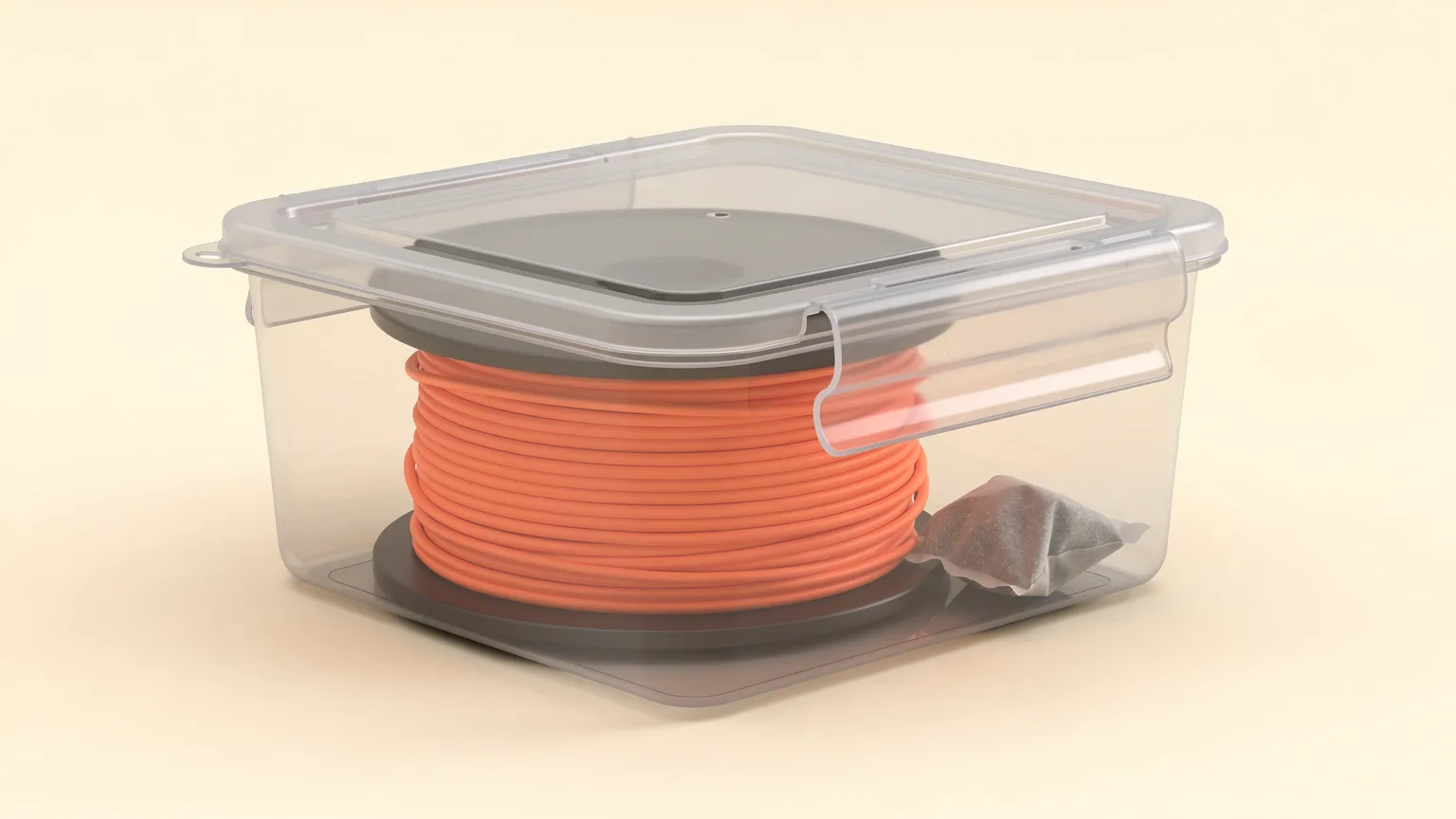
Most filament is hygroscopic, which means it pulls water vapor out of the air. Prusa's materials guide notes that PLA changes little as it takes on humidity, while polyamide (nylon) is affected quite significantly. The practical goal is simple: keep spools sealed with a desiccant, and measure the humidity so you are not guessing. This guide covers the setups that work, from a zip bag to a heated dry box.
This is a research article. It relies on manufacturer documentation (listed in the sources below), not on our own printing. Figures are the makers' recommendations and are a starting point.
Why storage matters more than drying
Bambu Lab's wiki explains the problem: moisture trapped in filament vaporizes in the hot nozzle, which causes bubbles, stringing, oozing, holes, rough surfaces and reduced strength. Prusa's guidance is blunt about the fix: it is best to avoid having to dry filament at all, and the way to do that is to store it in a closed space or box with desiccant.
If a spool has already gone damp, see how to dry filament. If you are not sure whether stringing comes from moisture or settings, the stringing guide shows the order to check things in.
How fast does filament absorb moisture?
Bambu Lab gives rough numbers that explain why a loose spool on a shelf is a bad idea:
- Typical indoor air sits at about 45% to 65% relative humidity (RH), and higher in humid weather.
- At around 55% RH, freshly dried filament will usually absorb enough moisture to affect print quality within about 2 to 12 hours, depending on the material.
- Most filaments can only stay dry for a limited time even below 20% RH. At 20% RH, Bambu Lab says filament generally stays dry for roughly 2 to 7 days. The lower the humidity, the longer it lasts.
Those figures are for open air. A sealed container with fresh desiccant is what brings the humidity around the spool down to those lower levels and keeps it there.
Which filaments need the most protection
Prusa tells owners to prioritize the most hygroscopic materials if storage space is limited. Its list of highly hygroscopic materials includes polyamide, polypropylene, PVA and BVOH, and it recommends either dry storage or drying them before every print. It also names polyamide, PVA and TPU as filaments that need drying more often than popular ones such as PLA.
Bambu Lab adds a warning for nylon-type filaments: after around 3 months of exposure to open air, they absorb so much moisture that they become very difficult to dry in a normal convection oven. For those, protect the spool with desiccant in a sealed container from day one.
A sensible order of priority:
- Nylon (PA), PVA, BVOH, TPU: sealed and desiccated at all times, or printed from a dry box.
- PETG, ABS and ASA: sealed storage is worth the effort.
- PLA: the least sensitive, but long exposure still shows up as stringing and rough surfaces.
Storage options, from cheapest to most capable
1. Resealable bag or vacuum bag with desiccant
Prusa lists vacuum bags as a popular way to keep filament dry. It says there are bags made for filament but that any bag that fits a spool will do, with a desiccant sachet kept inside. Squeeze out the air, seal it, and put the spool back in the bag every time you take it off the printer.
2. Airtight box with desiccant
A closed box with desiccant is the setup Prusa recommends first. You can buy one made for filament (Prusa sells its USS Drybox) or build your own. The box only works if the seal is good, so check the lid gasket and do not leave it open between prints.
3. Box with a hygrometer
Bambu Lab suggests using a hygrometer to see the actual humidity inside a sealed container. A small digital gauge is cheap and removes the guesswork. A reading near or below 20% RH matches Bambu's target for a container with desiccant. If it creeps up, replace or recharge the desiccant according to its maker's instructions.
4. A dry box that heats the filament
Active filament dryers both dry and store, and many let you print from the box. Prusa notes that you can usually keep the filament in the box while printing, but you should check that the dryer's temperature range matches your material. Our filament dryer buying guide covers what to look for.
Step by step: a simple storage routine
- When a spool comes off the printer, put it straight back into its bag or box. Do not leave it on the printer for days between jobs unless the printer holds it in a sealed dry box.
- Add fresh desiccant to the container. Color-changing desiccant makes it obvious when it is spent.
- Place a hygrometer inside the box so you can read the humidity without opening it.
- Keep the box somewhere cool, dark and away from direct sunlight and heat. Bambu Lab's safety notes on its filament say exactly this: a cool, dark, dry environment away from sunlight and high temperatures.
- Label each spool with the date opened, so you know which ones to test or dry first.
- Before an important print, check the signs: crackling at the nozzle, stringing that retraction changes cannot cure, or a fuzzy surface. If you see them, dry the spool.
Do not rely on a kitchen oven or microwave. Bambu Lab's wiki says not to use a microwave or a kitchen oven to dry filament, because microwave heating is uneven and a kitchen oven can have very hot areas near the heating elements that damage the spool or filament. Prusa adds that home ovens often cannot be set low enough for filament, and that their temperature readings are imprecise.
Common mistakes
- Storing spools in a sealed box without desiccant. The air that was in the box when you closed it is still there. Desiccant is what pulls the humidity down.
- Leaving the box open while you print. If a spool stays outside the box for days, the box protects nothing. Feed from the box or use a dryer that can be used while printing.
- Drying too hot. Prusa warns that exceeding the recommended drying temperatures makes filament soften and stick together. Its table lists 45 degrees C for PLA and 55 degrees C for PETG.
- Ignoring spool material. Prusa notes that older Prusament spools can loosen when heated above 45 degrees C. Check your spool before heating it. Newer black Prusament spools tolerate up to 90 degrees C according to Prusa.
How long can you store filament?
If it is sealed with desiccant and kept cool, dark and dry, there is no fixed date in the manufacturer documentation cited here, and the manufacturers focus on moisture rather than age. Whatever the label says, test an old spool with a short print before committing to a long one.
Material differences also matter for print settings: see PETG vs PLA. For the full range of drying temperatures and times from a major maker, see Prusa's drying guide and Bambu Lab's drying recommendations in the sources.
Frequently asked questions
What is the best way to store filament?
Keep it in a sealed container or vacuum bag with desiccant, away from heat and direct sunlight. Prusa and Bambu Lab both recommend this, and a small hygrometer inside the box lets you check the humidity.
What humidity should filament be stored at?
Bambu Lab says typical indoor air is about 45% to 65% relative humidity and that most filaments only stay dry for a limited time even at 20%. Aim for a sealed container reading at or below roughly 20% RH.
Does PLA need to be kept in a dry box?
PLA is the least affected of the common materials according to Prusa, but it still takes on moisture over time. Sealed storage is good practice, and more important for nylon, PVA, BVOH and TPU.
Can I use a kitchen oven to dry damp filament?
Bambu Lab advises against kitchen ovens and microwaves because heating is uneven and parts of the oven can get hot enough to damage the spool or filament. Prusa also says home ovens often cannot hold low enough temperatures. A filament dryer is the safer choice.
Sources

Founder and editor
Software engineer since 2009 and Head of Engineering by day, a maker who has owned several 3D printers, writing practical guides to 3D printers, filament and running costs, with every article saying what was and was not tested.
Keep reading
How Long Does a Spool of Filament Last?
A 1 kg spool holds about 349 meters of 1.75 mm PLA. Here is how to turn slicer weights into prints per spool, estimate how long it lasts, and what makes it run out faster.
12 October 2026 · 6 min read
PLA Print Temperature: Nozzle and Bed Settings
Prusa recommends 210 to 215 degrees C at the nozzle and 60 on the bed for PLA; Polymaker gives 190 to 230. Here is how to pick a starting point and tune it.
11 October 2026 · 5 min read
What Is Silk PLA? How It Differs From Standard PLA
Silk PLA is a glossy, decorative PLA that is weaker and more brittle than the basic kind. Here is how it differs from standard PLA and what to print with it.
11 October 2026 · 6 min read