3D Printer Starter Kit: Tools and Accessories You Actually Need
A no-fluff 3D printer starter kit built from the tool lists in Prusa and Bambu Lab maintenance documentation, with dated prices where they could be verified.
By Sepehr Sabbagh-pour · Published · 3 min read
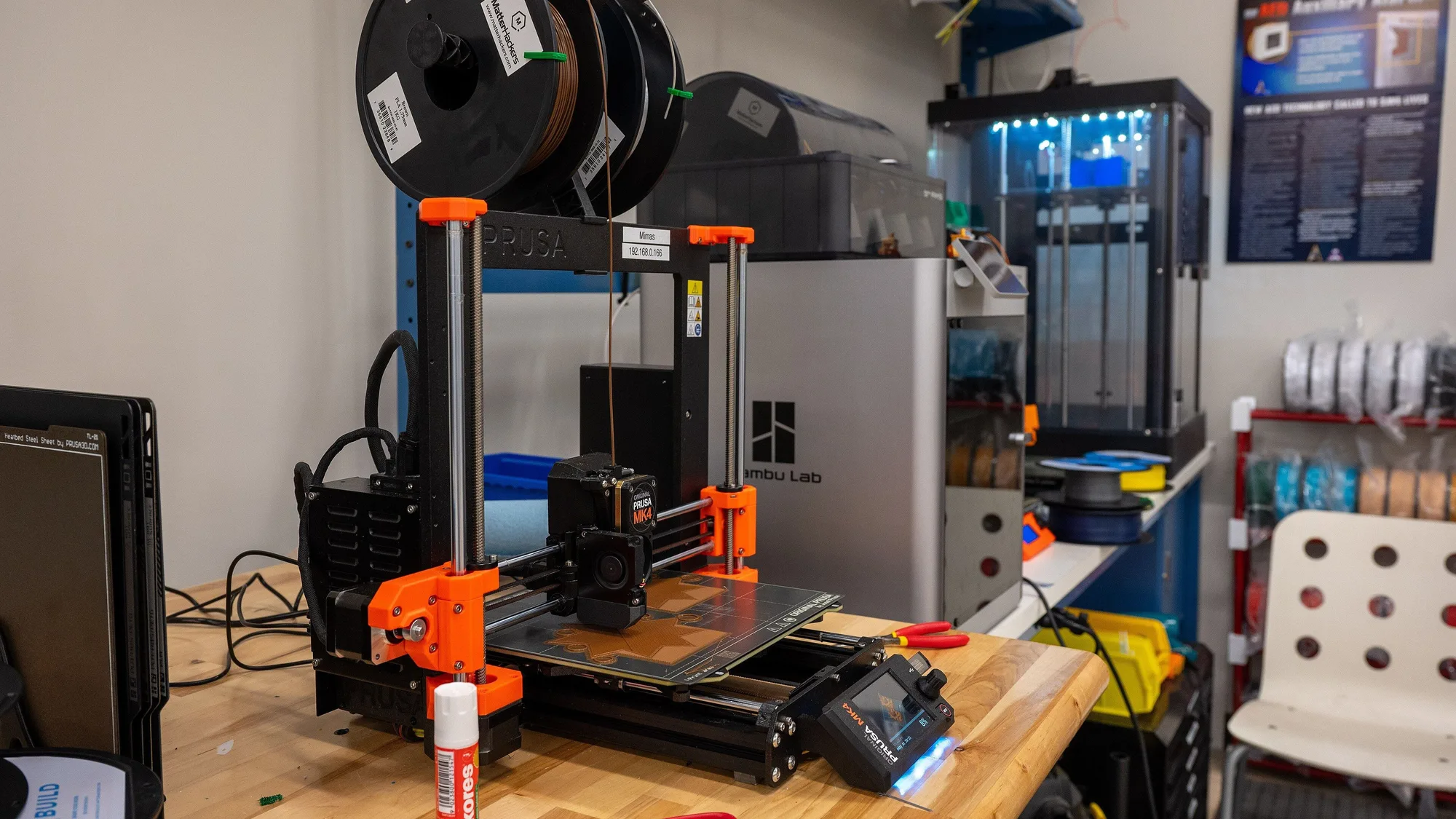
A 3D printer starter kit does not need to be big. The tool lists published by Prusa and Bambu Lab in their maintenance documentation are short, and most of what is on them is cheap. This guide is desk research from those pages and from store listings, not a test of any product. It sorts the extras into must-have, useful and skip-for-now.
If you only read one thing: buy hex keys, tweezers, isopropyl alcohol, a soft brush or blower, and the exact lubricant your manufacturer recommends. Everything else can wait until a problem shows you need it.
What the manufacturers say you need
Bambu Lab's A1 maintenance page lists these tools: a clean cloth, alcohol, lubricant oil, lubricant grease, hex keys, tweezers, heat-resistant gloves and an air blower. Prusa's CORE One page lists the usual tools such as Allen keys, needle-nose pliers, isopropyl alcohol (IPA) and paper towels, and adds compressed air, a brass nozzle brush, Prusa Lubricant, a linear rail lubrication set and an alcohol-free cleaner for panels.
That is the real core of a kit. Your own model may differ, so read its maintenance page too. Our maintenance checklist shows when each item gets used.
Must-have items
| Item | What it is for | Source |
|---|---|---|
| Hex keys | Belts, covers, hotend and extruder access | Bambu Lab, Prusa |
| Tweezers | Pulling filament scraps from rails, fans and the extruder | Bambu Lab |
| Isopropyl alcohol and cloth or paper towels | Cleaning rods, rails and some print sheets | Bambu Lab, Prusa |
| Brass nozzle brush | Removing plastic from the nozzle and heater block (Prusa says any hard-bristle brush will do) | Prusa |
| Manufacturer-approved lubricant | Rails, rods and lead screws | Bambu Lab, Prusa |
| Heat-resistant gloves | Handling a hot hotend area | Bambu Lab |
Take care with the lubricant. Bambu Lab says grease must not be used on the A1 X-axis linear rail, and Prusa says its general lubricant must not be used on the CORE One linear rail. Buy what your manual names and keep it labelled.
Useful items
- Air blower or compressed air. Both brands list one for clearing dust. Prusa warns not to hold a spray can upside down, and not to blow air on a running fan.
- Needle-nose pliers. Handy for pulling filament and holding small parts.
- A flexible scraper or spatula. For removing parts and first-layer purge lines. Check your plate's care notes first, since sheet coatings can be scratched.
- Side cutters. For trimming filament ends and removing supports. These are common hobby tools rather than something the maker pages list.
- Alcohol-free cleaner. Prusa says CORE One panels should be cleaned with an alcohol-free cleaner or soapy water, because alcohol can make them brittle.
Spare parts worth owning early
A spare print plate
On the UK-region Bambu Lab store on 2026-10-10, the Textured PEI Plate was listed at 17.99 GBP for the A1 mini and 31.99 GBP for the A1, P1 series, X1 series and P2S. Check which sheet fits your model. See our build plates explainer.
A spare nozzle
Nozzles clog and wear. Prusa publishes replacement guides and a printable replacement tool, and Bambu Lab sells replacement hotends. Pick the diameter you actually use, see nozzle sizes explained.
Filament to start with
PLA is the usual first material because it is the least fussy. Our PETG vs PLA comparison and the types of 3D printer filament guide help you choose later. For price context, on the UK-region Bambu Lab store on 2026-10-10 PLA Basic was listed at 13.99 GBP per 1 kg refill and 16.99 GBP per 1 kg spool with a reel. Prusa listed Prusament PLA Galaxy Black 1 kg at 29.99 GBP on its UK page the same day. At the Bambu Lab refill price, that works out at roughly 1.4 pence per gram. Our print cost calculator does the sums for a given part.
Keep filament dry. If prints turn rough or stringy, see how to dry filament.
What to skip for now
- Large upgrade kits. Wait for a problem. See first 3D printer upgrades worth making.
- Specialist finishing tools. Sanders, paint and hobby knives can wait until you have prints you want to finish.
- A dozen colors of filament. Learn on one or two spools.
Safety gear
Gloves help with hot parts, and good ventilation matters more than any accessory. Read 3D printer safety basics. If you are still choosing a printer, see how to choose your first 3D printer in the UK.
Frequently asked questions
What tools do I need for a 3D printer?
Manufacturer maintenance pages list hex keys, tweezers, isopropyl alcohol, a cloth, a brush for the nozzle, an air blower and the correct lubricant. Heat-resistant gloves are listed by Bambu Lab.
What accessories should a beginner buy first?
A spare print plate, a spare nozzle and the basic tools above cover most early problems. Wait for a specific problem before buying larger upgrades.
Can I use any grease on my 3D printer?
No. Bambu Lab and Prusa both say certain rails must not receive grease or the wrong lubricant. Use the lubricant your manual names for each part.
How much does a spool of PLA cost?
On 2026-10-10 the UK-region Bambu Lab store listed PLA Basic refills at 13.99 GBP per kilogram, and Prusa listed Prusament PLA at 29.99 GBP per kilogram. Prices change, so check the current listing.
Do I need a filament dryer when starting out?
Not always. If you use PLA and store it sealed, you may be fine, but PETG, nylon and TPU absorb moisture more readily. Dry filament if you see stringing or rough surfaces.
Sources

Founder and editor
Software engineer since 2009 and Head of Engineering by day, a maker who has owned several 3D printers, writing practical guides to 3D printers, filament and running costs, with every article saying what was and was not tested.
Drafted with AI assistance, then edited and reviewed by Sepehr before it goes live. How we use AI.
Keep reading
Multicolor 3D Printing Explained: AMS, Tool Changers and Waste
Multicolor FDM prints change filament mid-print. Single-nozzle systems must flush the old color out, which creates waste. Tool…
 AI illustration
3D Printer Enclosure: Do You Need One and Which to Get
An enclosure matters for ABS, ASA and nylon and does little for PLA. Here is when to get one, what it cannot do, and how buying…
Enclosed vs Open-Frame 3D Printers: Which Do You Need?
An enclosure helps with some materials and noise, and hurts with others. Here is a plain way to decide which style fits what you…