Types of 3D Printer Filament: PLA, PETG, ABS, TPU and More
Six plastics cover most home printing, plus filled and specialty blends. Here is what each is good at, what it demands from your printer, and how to choose without overthinking it.
By Sepehr Sabbagh-pour · Published · Updated · 7 min read
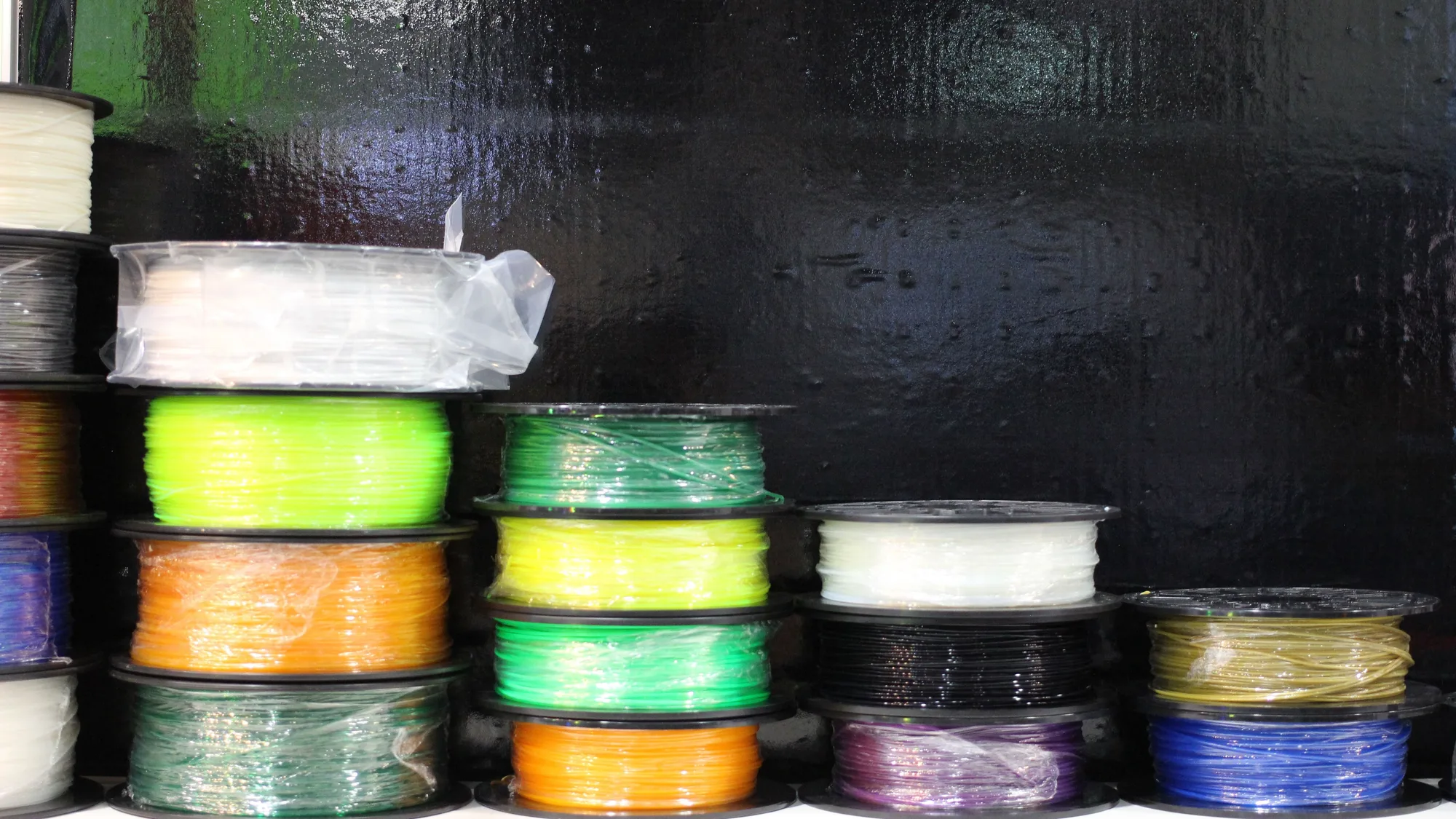
The main types of 3D printer filament are PLA, PETG, ABS, ASA, TPU and nylon, plus filled blends such as carbon fiber, wood and silk PLA. PLA suits beginners, PETG adds toughness, ABS and ASA add heat resistance, TPU bends and nylon is tough but fussy. Settings below come from Prusa and Bambu Lab.
What are the main types of 3D printer filament?
Six plastics cover most home printing, and each trades ease of printing against toughness, heat resistance or flexibility. The table summarizes how the makers describe them; every row links to a page with more detail further down.
| Filament | How hard is it to print? | Strengths | Main drawbacks |
|---|---|---|---|
| PLA | Easy; Prusa calls it suitable for beginners | Low price, good detail, low warping | Brittle and inflexible; low UV and temperature resistance |
| PETG | Easy to moderate (Prusa lists it as easy; Bambu Lab rates it medium) | Tough, good layer adhesion, water and humidity resistant, low warping | Strings, poor bridging and overhangs, bonds strongly to smooth PEI |
| ABS | Moderate; Bambu Lab rates it medium | High tenacity, good heat resistance, can be smoothed with acetone | Significant warping, needs an enclosure, styrene fumes, no UV resistance |
| ASA | Harder than PLA: Prusa lists significant warping and a high print temperature | High UV resistance, heat resistance up to 93 °C, impact and wear resistance | Significant warping, enclosure needed for large parts, fumes, high print temperature |
| TPU | Hard; Prusa lists high print difficulty | Flexible, tough, good layer adhesion, chemical resistance | Slow printing, stringing, poor bridging, absorbs moisture |
| Nylon (PA) | Very hard; Prusa recommends it for experienced users | Great mechanical resistance, high temperature resistance | Prone to warping, highly hygroscopic |
Which type of filament should a beginner start with?
PLA. Bambu Lab's beginner guide calls it the best choice when you are just starting out, with relatively predictable results, and says other materials are not recommended until you are confident with it. Prusa lists easy printing, good detail and low warping among its pros. Its main weakness is heat: Prusa says PLA softens and deforms above about 60 °C and is not suited to technical or outdoor use.
See how to 3D print for a first print, PLA print temperature for settings, and PLA Plus vs PLA if you are weighing a modified blend.
PLA and silk PLA: the default for models
Standard PLA suits concept models, prototypes, detailed figures and low-wear toys, according to Prusa. Silk PLA is the same family tuned for looks: Polymaker describes its Panchroma Silk as a PLA with a high gloss effect for display models, props and decorative prints, designed for aesthetics and not meant for high-load or mechanical parts. Our silk PLA explainer compares it with standard PLA.
PETG: the tougher all-rounder
PETG is the usual step up from PLA when a part must survive handling, moisture or moderate heat. Prusa lists it as tough and durable, with good layer adhesion and low warping, and says parts suit interior use and most exterior use below 80 °C. The price is a harder time with stringing, bridges and overhangs, and Prusa warns against printing it on a smooth PEI sheet because it can stick too strongly.
Read what PETG is for properties, PETG vs PLA for the head-to-head, PETG print temperature for settings and how to stop PETG stringing if strands appear.
Should you print ABS or ASA?
Only if you need more heat resistance than PETG gives and you have an enclosed printer. Prusa says ABS requires an enclosure, warps significantly and releases potentially dangerous styrene fumes, so it should be printed in a well-ventilated room. ASA behaves similarly but adds high UV resistance, which is why Prusa recommends it for outdoor and technical parts, and lists a temperature resistance of up to 93 °C. Bambu Lab's compatibility table groups ABS, ASA, PC and nylon as materials that need an enclosed printer.
The detail pages are ABS print settings, ASA vs ABS and ABS vs PETG. If ABS parts crack between layers, see how to fix ABS cracking, and if you are deciding on a printer, read enclosed vs open-frame 3D printers.
TPU: for parts that have to bend
TPU is a flexible filament, a type of thermoplastic elastomer, and it has to be printed slowly. Prusa says TPU is usually around 60A to 90A in hardness and that the softer it is, the harder it is to print. It suggests a typical speed of about 20 mm/s with a maximum of 30 to 40 mm/s, and recommends flexible printing mainly for experienced users. It suits stamps, tires, shoe soles, belts and washers. See what is TPU.
Nylon: tough but fussy
Nylon (polyamide) is the material to reach for when a part needs strong mechanical and temperature resistance, such as gears. Prusa recommends it for experienced users: it warps, and it is highly hygroscopic, with poorly stored spools able to absorb water up to 10% of the filament's weight. Our nylon filament guide covers the printer requirements.
What are filled and specialty filaments?
Filled filaments are a base plastic such as PLA, PETG or nylon mixed with fibers or powders, and they change both the finish and what your nozzle must survive. Three kinds are common:
- Carbon and glass fiber. Prusa says the fibers improve dimensional stability and reduce warping but make the filament more brittle, with worse layer adhesion and a higher clogging risk. They are highly abrasive, so a hardened steel nozzle is required. Bambu Lab's first choice for these materials is a 0.6 mm hardened steel nozzle and it says not to use a 0.2 mm nozzle. See what is PETG-CF and hotends and nozzle materials.
- Wood and metal fill. Mostly decorative. Prusa says wood-filled and other large-particle composites need a nozzle of at least 0.6 mm with a 0.2 mm layer height to avoid clogs, and metal-filled types are highly abrasive. See what is wood filament.
- Silk and other effect PLA. Covered above under silk PLA.
Does each type of filament need a different printer?
Partly: enclosure, nozzle and temperature limits decide what your machine can run. Bambu Lab says PLA, PETG and TPU are not prone to warping and run on open-frame or enclosed printers, although it recommends an enclosure for PETG to keep low ambient temperatures from reducing interlayer strength. ABS, ASA, PC and nylon need higher bed and chamber temperatures, so it recommends an enclosed printer for them.
| Filament | Prusa nozzle / bed | Bambu Lab beginner guide nozzle / bed | Printer type (Bambu Lab) |
|---|---|---|---|
| PLA | 215 °C first layer, 210 °C after / 60 °C | 190 to 230 °C / 35 to 55 °C | Open-frame or enclosed |
| PETG | 230 °C first layer, 240 °C after / 85 °C first layer, 90 °C after | 220 to 250 °C / 50 to 80 °C | Open-frame or enclosed; enclosed recommended |
| ABS | 255 °C / 100 °C (80 to 110 °C) | 220 to 250 °C / 80 to 100 °C | Enclosed |
| ASA | 260 °C / 105 °C first layer, 110 °C after | Not listed | Enclosed |
| TPU | 230 to 245 °C / 60 to 75 °C | Not listed | Open-frame or enclosed |
| Nylon (PA) | 285 °C / 110 °C | Not listed | Enclosed |
| Carbon or glass fiber filled | 240 to 285 °C / 70 to 110 °C | Not listed | Same as the base plastic; hardened steel nozzle |
The two makers' ranges differ because their products and printers differ, so the label on your own spool wins. For nozzle diameters and what they change, see 3D printer nozzle sizes, and for the surface PETG and ABS stick to, see 3D printer build plates.
How should you store and dry each type of filament?
Most filaments absorb water from the air, and the sensitive ones need the most care. Prusa says PLA changes little with humidity while polyamide is significantly affected, and it calls polyamide, polypropylene, PVA and BVOH highly hygroscopic. TPU also needs drying more often than PLA. Keep spools in a sealed box with desiccant and dry them to the maker's temperature when they string or print roughly.
The detail is in how to store filament, how to dry filament, how to choose a filament dryer and does filament expire.
How do you choose between filament types?
Pick the easiest material that does the job, because every step down the table adds printing difficulty. Work down this list:
- Start with PLA for models, prototypes and anything that stays cool, indoors and unstressed.
- Choose PETG if the part will be knocked about, get wet or sit somewhere warm, below about 80 °C.
- Choose ASA or ABS only if you have an enclosed printer and need more heat resistance, with ASA the pick for sunlight.
- Choose TPU when the part must flex, and slow the print down.
- Choose nylon or a fiber-filled blend for engineering parts, and plan for dry storage, an enclosure and a hardened steel nozzle.
For cost per spool see how much 3D printer filament costs and cheap vs premium filament. Check the diameter your printer takes in 1.75 mm vs 2.85 mm filament, and if you own a Bambu Lab printer read the Bambu Lab filament guide. To estimate how long a spool lasts, see how long a spool of filament lasts.
Research-based guide. This page compares maker documentation and has not been checked on a test printer. The figures are the makers' recommendations, not our measurements.
Frequently asked questions
What are the most common types of 3D printer filament?
The most common types are PLA, PETG, ABS, ASA, TPU and nylon. PLA is the easy default for models and prototypes. PETG is tougher and handles moisture and moderate heat. ABS and ASA resist more heat, with ASA adding UV resistance for outdoor parts, but both need an enclosed printer and ventilation. TPU is flexible and prints slowly. Nylon (polyamide) is strong and heat-tolerant but warps and absorbs moisture. On top of these sit filled and specialty blends, such as carbon fiber, wood-filled and silk PLA. Prusa and Bambu Lab both document these materials, and their temperature ranges differ, so always check the label on your spool.
Which type of filament should a beginner use?
PLA. Bambu Lab's beginner guide calls PLA the best choice if you are just getting started, because it gives relatively predictable results, and says to avoid switching to other materials until you are confident with it. Prusa lists easy printing, good detail, low warping and low price as PLA's strengths. The trade-off is that it is brittle and softens above about 60 °C, so it is a poor fit for parts left in a hot car or in sunlight. Once your first layers are reliable, PETG is the usual next step for tougher parts, and it takes a little more effort to get right.
Do I need an enclosure for ABS or ASA?
Yes, in practice. Prusa lists a required enclosure as a drawback of ABS and says an enclosure is necessary for printing large ASA parts, because both warp significantly. Bambu Lab's compatibility table recommends an enclosed printer for ABS, ASA, polycarbonate and nylon, since they need higher bed and chamber temperatures to avoid warping and layer separation. Without an enclosure, Prusa suggests turning on the draft shield in PrusaSlicer's skirt and brim settings to keep the model warmer. Both materials also release potentially dangerous styrene fumes, so print them in a well-ventilated room and follow the manufacturer's safety guidance. On an open-frame printer, PLA, PETG and TPU are the safer choices, because Bambu Lab lists all three as suitable for open-frame or enclosed machines.
Which filament types need a hardened steel nozzle?
Abrasive ones. Prusa says carbon, glass and Kevlar fibers are highly abrasive and require a hardened nozzle, that metal-filled filaments are highly abrasive, and that a regular brass nozzle wears quickly with some glow-in-the-dark filaments. Bambu Lab says to always use a hardened steel nozzle for carbon fiber or glass fiber reinforced materials, with a 0.6 mm hardened nozzle as the first choice and 0.4 mm as the second, and to avoid 0.2 mm nozzles because the clogging risk is extremely high. Standard PLA, PETG, ABS, ASA and TPU do not need one. Fit a hardened nozzle before you start printing an abrasive filament.
Which types of filament absorb the most moisture?
Nylon, polypropylene, PVA and BVOH absorb the most. Prusa calls polyamide, polypropylene, PVA and BVOH highly hygroscopic and advises keeping them dry or drying them before every print, and it says poorly stored nylon can absorb water up to 10% of its weight. It also says TPU needs drying more often than PLA, while PLA changes little with humidity. Bambu Lab marks drying before use as required for TPU, polycarbonate, PVA and nylon types and as recommended for PLA, PETG and ABS. Wet filament causes stringing, rough surfaces and weak layers, so store spools sealed with desiccant and dry them when problems appear.
Sources
- PLA material guide, Prusa Knowledge Base
- PETG material guide, Prusa Knowledge Base
- ABS material guide, Prusa Knowledge Base
- ASA material guide, Prusa Knowledge Base
- Flexible materials, Prusa Knowledge Base
- Polyamide (Nylon), Prusa Knowledge Base
- Composite materials (filled with carbon, kevlar or glass), Prusa Knowledge Base
- Composite materials (with metal or wood particles), Prusa Knowledge Base
- Drying filament, Prusa Knowledge Base
- Filament guide for beginners, Bambu Lab Wiki
- Filament guide and material table, Bambu Lab Wiki
- Filament Drying Recommendations, Bambu Lab Wiki
- Panchroma Silk PLA, Polymaker Wiki

Founder and editor
Software engineer since 2009 and Head of Engineering by day, a maker who has owned several 3D printers, writing practical guides to 3D printers, filament and running costs, with every article saying what was and was not tested.
Drafted with AI assistance, then edited and reviewed by Sepehr before it goes live. How we use AI.
Keep reading
 AI illustration
Types of 3D Printer Resin: Standard, Tough and More
Resin comes in a few families: standard, water-washable, ABS-like or tough, flexible and specialty. What each is for, what it…
 AI illustration
What Is TPU? A Guide to Printing Flexible Filament
TPU is a flexible, wear-resistant filament for grips, gaskets and tires. Here is what it is, how hardness works and how makers…
PETG vs PLA: Which Filament Should You Use?
PLA is the easy default, PETG is the tougher all-rounder. Here is how they differ on temperature, strength, heat, warping and…