Hotends and Nozzle Materials: Brass vs Hardened Steel
Brass is the standard nozzle for PLA and PETG, but abrasive filaments wear it fast. Learn what a hotend is, how hardened steel and other nozzles differ, and when you need one.
By Sepehr Sabbagh-pour · Published 12 October 2026 · 6 min read
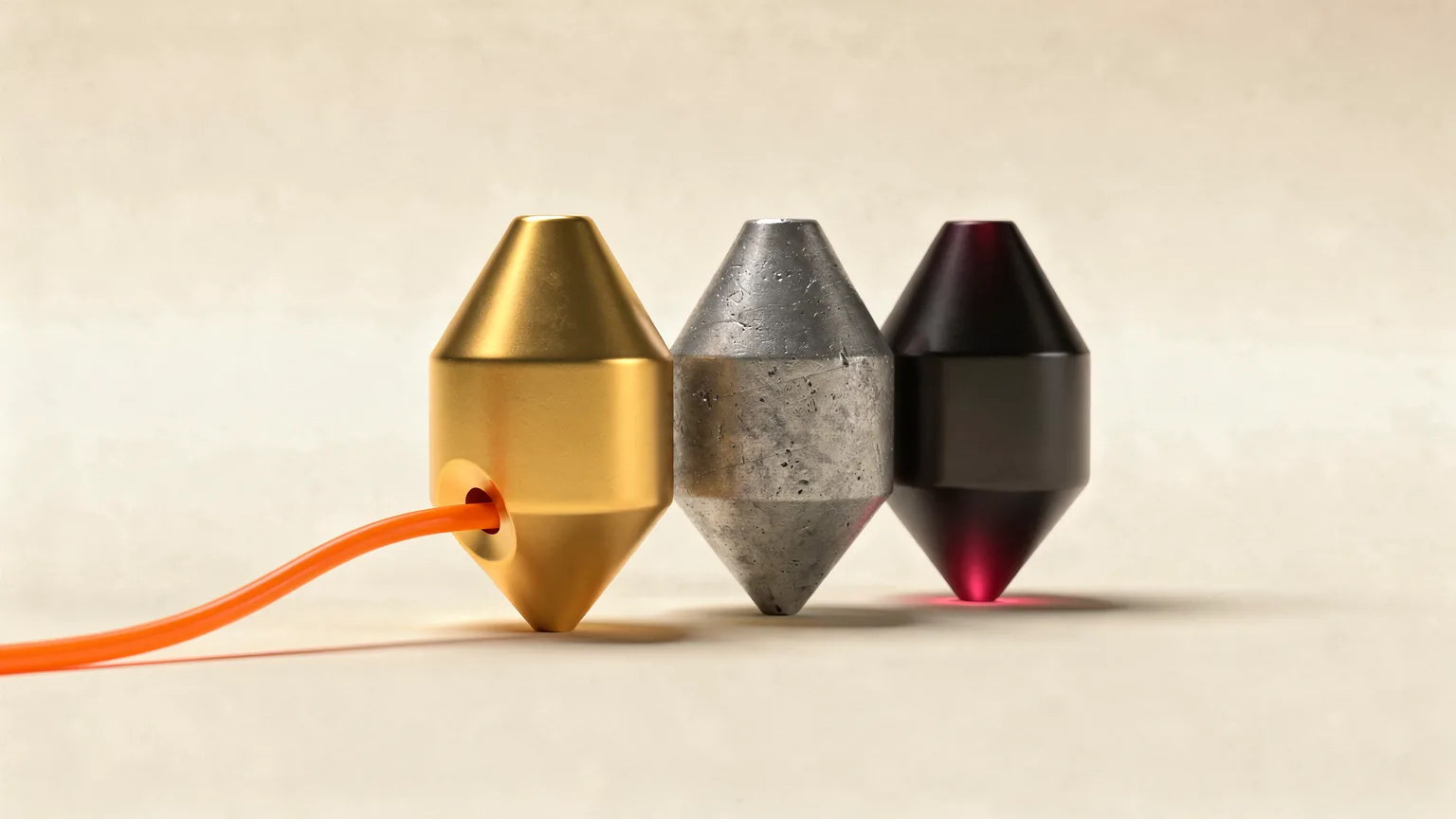
The nozzle is the small metal tip that the melted plastic comes out of. It sits at the end of the hotend, the heated assembly that melts the filament. Brass is the usual nozzle material, and hardened steel is the common upgrade for filament that wears brass away.
This is a research explainer based on maker documentation and store pages, checked on 2026-10-10. It is not a test. Always follow your own printer's guidance before swapping parts.
What a hotend and nozzle do
In fused filament fabrication, filament is fed from a spool through a heated extruder head and deposited layer by layer on the growing part. The hotend is the heated part of that head: it melts or softens the plastic and forms it into a thin continuous strand. The nozzle is the replaceable tip that sets the line width through its opening, which is why nozzle size matters for detail and speed.
The nozzle gets hot, and every gram of filament passes through it. That is why its material matters: it has to conduct heat, resist wear and, for some filaments, resist corrosion.
Brass nozzles
Prusa fits a brass nozzle to its FFF printers and says brass has excellent heat conductivity and is tough enough to print most common filaments. Its documentation describes the brass nozzle as cost-effective, easy to clean and a good fit for everyday printing with non-abrasive filaments.
The weakness is wear. Prusa states that a brass nozzle is not recommended for abrasive filaments, because they can cause rapid wear.
Prusa also sells brass variants for faster printing. Its CHT nozzle splits the filament flow into three streams for better heat distribution, which Prusa says enables higher speeds while keeping output consistent. Its E3D High Flow Brass nozzle splits the flow into four channels and, according to Prusa, works effectively at lower temperatures than conventional nozzles.
Hardened steel nozzles
Hardened steel is chosen for wear resistance. Prusa's documentation lists several options:
- ObXidian. A hardened steel nozzle with a coating. Prusa calls it particularly suitable for abrasive materials like carbon fiber, and says it keeps its hardness at higher temperatures. Prusa does not recommend cold pulls on it because they can tear off the coating, and advises cleaning with a non-abrasive cloth rather than needles or brass brushes.
- Hardened (nickel plated). Hardened steel with a nickel coating. Prusa says it offers good durability against abrasive filaments while reducing friction, and is suited to people who switch often between abrasive and non-abrasive materials.
- High Flow ObXidian. A hardened steel nozzle that combines abrasion resistance with heat tolerance and flow optimization, aimed at large prints or speed.
- DiamondBack. A nozzle with a polycrystalline diamond insert at the tip. Prusa says the tip is a solid diamond insert, not a coating, and positions it for metal and ceramic filled filaments.
Elegoo takes another route: it lists a 320 C hotend with a brass-hardened steel nozzle for its Centauri Carbon, described as heat and wear resistant. Check the maker's wording for which parts of the nozzle are hardened.
Stainless steel stock nozzles
Bambu Lab ships a 0.4 mm stainless steel nozzle with the A1 mini and P1S, each with an all-metal hotend rated to 300 C. The A1 mini specification table lists PLA, PETG, TPU and PVA as supported and carbon and glass fiber reinforced polymers as not recommended. The P1S table also lists carbon and glass fiber reinforced polymers as not recommended. Treat that as a signal to buy a hardened hotend or nozzle designed for your model before printing fiber-filled filaments.
Which filaments are abrasive?
Abrasive filaments contain hard particles that scrape the inside of the nozzle. The ones makers name most often are carbon fiber and glass fiber filled filaments. Prusa also lists metal and ceramic filled filaments among those suited to its DiamondBack nozzle. Check the filament maker's data sheet for any other filament you are unsure about.
| Filament | Brass OK? | Hardened steel advised? |
|---|---|---|
| Standard PLA, PETG, ABS, ASA, TPU | Yes, per Prusa's guidance for non-abrasive filaments | Not needed |
| Carbon fiber or glass fiber filled | Not recommended | Yes |
| Metal or ceramic filled | Not recommended | Yes, or a diamond-tipped nozzle per Prusa |
Our guide to PETG-CF covers one filled material in more detail. For standard materials, see PLA, PETG, ABS and TPU compared.
Nozzle size and filled filaments
Prusa's compatibility chart gives these guidelines: a 0.25 mm nozzle is best for precision with PLA, ASA/ABS, PETG, PC blend and nylon, and it says to avoid flexible and composite materials. A 0.4 mm nozzle is versatile, and supports standard and composite materials when the nozzle is hardened. Sizes of 0.6 to 0.8 mm suit functional parts and faster printing, with potential warping with ASA and PC blend.
Choosing and swapping a nozzle
- List the filaments you plan to print. If none are abrasive, stay with the stock nozzle.
- If you want carbon fiber, glass fiber, metal or ceramic filled filament, buy a nozzle sold for your exact printer. Prusa nozzles differ between its Nextruder printers and E3D V6 printers, and an adapter exists to fit V6 nozzles to a Nextruder.
- Update the nozzle type and diameter in the printer settings and slicer profile after the swap, and follow the maker's temperature guidance for that nozzle.
- Use filament with tight diameter tolerance. Prusa recommends its own Prusament, quoting a diameter variation of plus or minus 0.02 mm, to avoid clogging.
- Replace worn nozzles. If under-extrusion or clogs keep returning with no other cause, a worn or damaged nozzle is one thing to check; see fixing a clogged nozzle and fixing under-extrusion.
High-temperature hotends
Nozzle material is only half of the picture. Prusa sells an HT hotend upgrade for the CORE One L+ that it says reaches up to 400 C for engineering materials, and the same page mentions carbon-fiber reinforced PEKK and PPS. Most desktop printers max out far lower: Bambu Lab lists 300 C for the A1 mini and P1S, and Elegoo lists 320 C for the Centauri Carbon. Such materials also need an enclosure and the right build plate; see build plates compared.
If you only read one thing. Keep brass for normal PLA, PETG, ABS and TPU. Buy hardened steel before your first fiber-filled or metal-filled spool, and follow the cleaning guidance for coated nozzles.
Frequently asked questions
Do I need a hardened steel nozzle?
Only for abrasive filaments, such as carbon fiber, glass fiber, metal or ceramic filled types. For standard PLA, PETG, ABS, ASA and TPU, Prusa's guidance is that brass is tough enough.
What is the difference between a brass and a hardened steel nozzle?
Brass conducts heat well and is cheap, but wears quickly with abrasive filament. Hardened steel resists that wear. Prusa lists coated and plated hardened options, and a diamond-tipped nozzle for metal and ceramic filled materials.
Can I use a hardened steel nozzle for normal PLA?
Yes, makers sell hardened nozzles aimed at people who switch between abrasive and non-abrasive materials. Prusa describes its nickel-plated hardened nozzle that way. Use the temperature settings recommended for your printer and nozzle.
Can I do a cold pull with a coated hardened nozzle?
Check the maker first. Prusa says it does not recommend cold pulls on its ObXidian nozzle because they can tear off the coating, and advises cleaning with a non-abrasive cloth.
Are stock Bambu Lab nozzles suitable for carbon fiber filament?
Bambu Lab lists carbon and glass fiber reinforced polymers as not recommended in the specifications for the A1 mini and P1S, which come with a stainless steel nozzle. Use a hardened hotend or nozzle designed for your model.
Sources

Founder and editor
Software engineer since 2009 and Head of Engineering by day, a maker who has owned several 3D printers, writing practical guides to 3D printers, filament and running costs, with every article saying what was and was not tested.
Keep reading
Is 3D Printing Worth It? An Honest Cost and Time Check
Is 3D printing worth it for you? This guide breaks down printer and filament prices, time and upkeep, and gives a checklist to decide before you buy.
12 October 2026 · 8 min read
3D Printer Maintenance Checklist
A practical 3D printer maintenance checklist: daily cleaning, monthly rail and fan checks, and quarterly lubrication, drawn from Bambu Lab and Prusa documentation.
11 October 2026 · 6 min read
First 3D Printer Upgrades Worth Making
The best first 3D printer upgrades fix a specific problem. This guide ranks plates, nozzles, drying and enclosures by when they make sense, using maker documentation and store prices.
11 October 2026 · 7 min read