CoreXY vs Bed Slinger 3D Printers
A bed slinger moves the bed back and forth; a CoreXY printer keeps the bed still in XY and moves a light toolhead with two fixed motors. Here is what that means for you.
By Sepehr Sabbagh-pour · Published 10 October 2026 · 7 min read
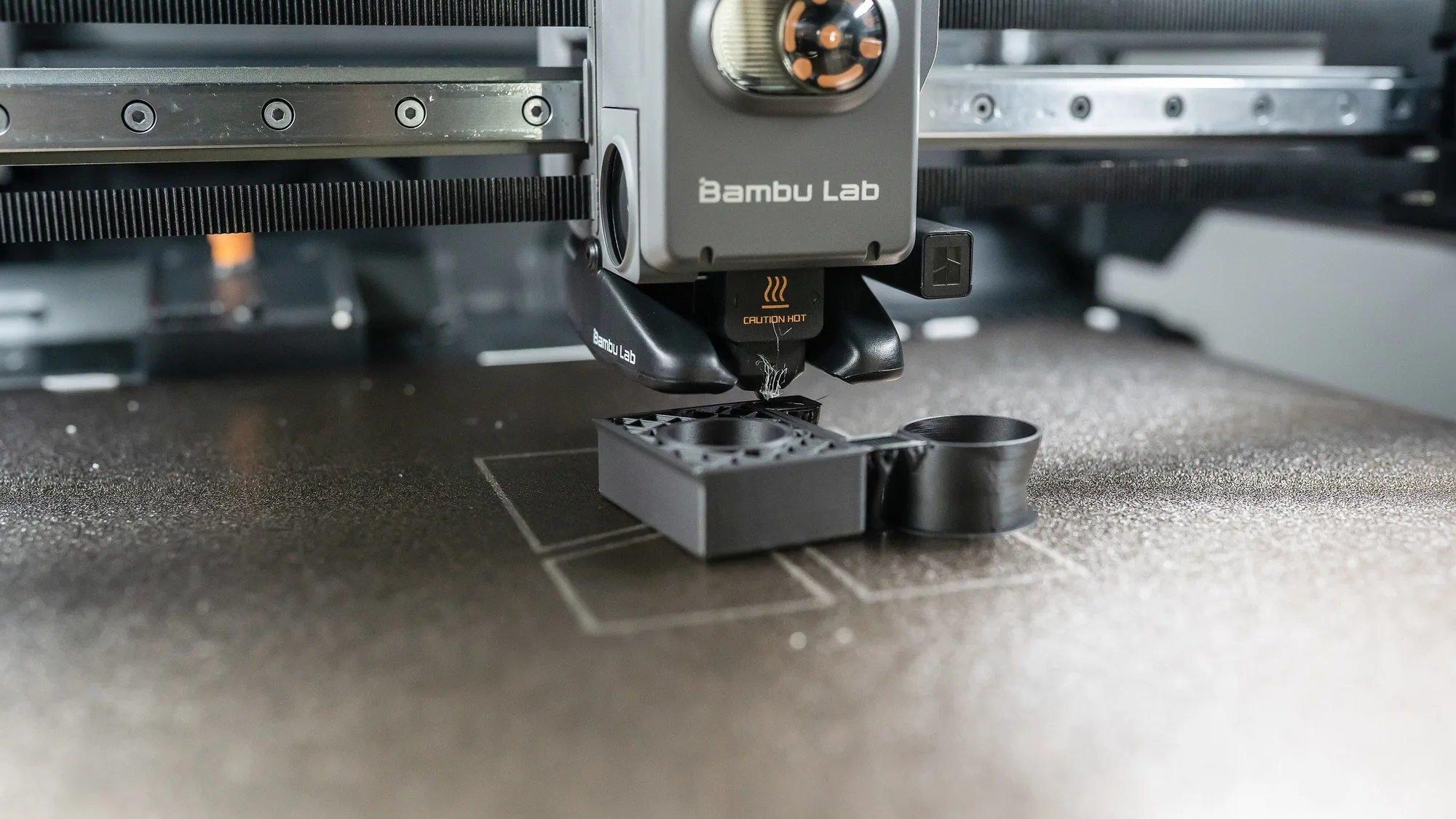
Two layouts dominate desktop FDM printers: the bed slinger and CoreXY. They differ in what moves when the printer draws a line. This is a research-based comparison drawn from reference material and maker guides. It has not been tested by us, and any speed advantage depends on the specific printer.
The short answer
- Choose a bed slinger if you want a simpler, often cheaper machine and print mostly small to medium parts at moderate speed.
- Choose CoreXY if you want faster printing, you print tall or heavy parts, or you want a design that keeps the printed object still while the head moves.
- The label is not a quality guarantee. A well-built bed slinger can beat a poorly built CoreXY printer.
How a bed slinger works
Wikipedia defines a bed slinger as a Cartesian variant where the build surface moves along the Y axis while the print head moves along the X axis. It names the Prusa i3 and its clones as examples of this technique. Each axis has its own motor and a clear job, which makes the machine easy to understand and inspect.
The catch is what travels with the bed. Flashforge notes that the printer has to move the combined weight of the bed, build plate and the print itself every time the Y axis changes direction. The taller or heavier the print, the more that mass matters.
How CoreXY works
Wikipedia describes CoreXY as a kinematic system where the two motors that move the head in the horizontal plane are stationary and do not move themselves, which can mean less moving mass. Belts connected in a crossed pattern turn the two motors' combined rotation into X and Y motion. For movement along X, both motors turn the same way. For movement along Y, they turn in opposite directions. If only one motor turns, the head moves diagonally.
The Klipper documentation expresses the same idea in firmware terms: on a CoreXY machine, stepper A follows x plus y and stepper B follows x minus y, while Z is independent, as on a basic Cartesian machine. In practice this means your slicer and G-code still think in normal X, Y and Z, and the printer handles the belt math.
On most CoreXY printers the bed moves only in Z, so the print stays still in the horizontal plane. Wikipedia says this can allow increased printing speed compared with Cartesian machines that use the same filament-based process, because of the lower moving mass.
CoreXY vs bed slinger side by side
| Bed slinger | CoreXY | |
|---|---|---|
| What moves in Y | The bed, plate and print | The toolhead, driven by belts |
| XY motors | One per axis, one rides on the moving axis | Two, fixed to the frame |
| Moving mass | Includes the print | Lower; the print stays still in XY |
| Tall or heavy prints | Often need gentler acceleration | Generally more stable, per Flashforge |
| Mechanical complexity | Simpler and easy to inspect | More involved belt routing; tension on both belts matters |
| Typical price position | Often lower | Often higher; check current listings |
Speed and print quality
The lighter moving mass on CoreXY is the main reason it is associated with speed. Less mass changing direction makes high acceleration easier to manage and can reduce the vibration patterns known as ringing. Flashforge says CoreXY designs support higher speeds and better stability for tall prints, and also warns that CoreXY still depends on belt tension, pulley alignment, frame rigidity and calibration, and that the label alone does not guarantee better print quality.
Speed on a bed slinger is limited most by the moving bed. Flashforge says a calibrated bed slinger can produce detailed models and useful parts, though it may need more conservative acceleration settings for large or tall prints. Faster is not automatically better, either: see our guide to print speed vs quality for the trade-offs.
Tall prints
With a bed slinger, a tall print is a tall object riding on a platform that is thrown back and forth. A CoreXY printer keeps it still in the XY plane. That is why tall, thin models are often cited as one place where CoreXY has an advantage. Flashforge lists tall-print stability among the strengths of CoreXY.
Maintenance and ownership
A bed slinger is easier to read. Belts, rails and wiring tend to be visible and accessible, and troubleshooting is often straightforward according to Flashforge. CoreXY needs both belts tensioned correctly and routed properly. If you plan to maintain the machine yourself, a simpler layout can be less intimidating. Whatever you pick, our bed leveling guide applies to both.
Enclosures and build volume
A moving bed needs clear space around it, which is one reason many open-frame bed slingers are not enclosed. Enclosure matters for materials like ABS and for noise, and it is a separate decision from the motion system. See enclosed vs open-frame printers. For build volume, compare the stated figures on the maker's spec page: the motion system does not dictate size.
Which should you choose?
A simple rule. If your budget is tight and your prints are small to medium, a bed slinger is a sensible, easy-to-understand choice. If you print often, print large or tall, and want speed, favor CoreXY and budget a little more. Check the maker's spec page for the motion system, since it is usually listed.
Two machines from the same brand can show the difference clearly. Our Bambu Lab A1 vs P1S comparison is a research-based look at two specific models, and the first printer checklist covers the rest of the buying decision.
Frequently asked questions
Is CoreXY better than a bed slinger?
CoreXY has less moving mass, which supports higher speed and better stability on tall prints, but it is more complex and often costs more. A well-calibrated bed slinger can print clean parts at moderate speeds. Neither is better for every user.
What does bed slinger mean in 3D printing?
A bed slinger is a printer where the build surface moves back and forth along the Y axis while the print head moves along the X axis. The Prusa i3 design and its clones are cited examples.
Why is CoreXY faster?
The two motors that drive the head in the XY plane are fixed to the frame, so the moving part is lighter. Wikipedia says this can increase printing speed. Real speed still depends on frame rigidity, belts and tuning.
Is a CoreXY printer harder to maintain?
It has more involved belt routing and both belts need correct tension, so there is more to set up. A bed slinger is mechanically simpler and easier to inspect. Follow the maker's maintenance guide for your printer.
Sources

Founder and editor
Software engineer since 2009 and Head of Engineering by day, a maker who has owned several 3D printers, writing practical guides to 3D printers, filament and running costs, with every article saying what was and was not tested.
Keep reading
Anycubic Kobra S1: Specs, Price and Who It Suits
Anycubic Kobra S1 Combo specs, launch price and who it suits, from Anycubic's own pages. Not tested by us.
10 October 2026 · 5 min read
Bambu Lab A1: Specs, Price and Who It Suits
The Bambu Lab A1 is an open-frame 256 mm bed slinger sold from £209 in the UK store. Here are the maker's specs, prices and who it suits. Not tested by Nozzle Notes.
10 October 2026 · 5 min read
Bambu Lab A1 mini: Specs, Price and Who It Suits
The Bambu Lab A1 mini is the smallest and cheapest current Bambu Lab printer here at £149 in the UK store. Maker specs, prices and who it suits. Not tested by Nozzle Notes.
10 October 2026 · 5 min read