Does Filament Expire? Shelf Life and Storage
Filament has no standard expiry date, but moisture and age can ruin a spool. What makers say about shelf life, how to spot bad filament, and how to dry and store it.
By Sepehr Sabbagh-pour · Published · 4 min read
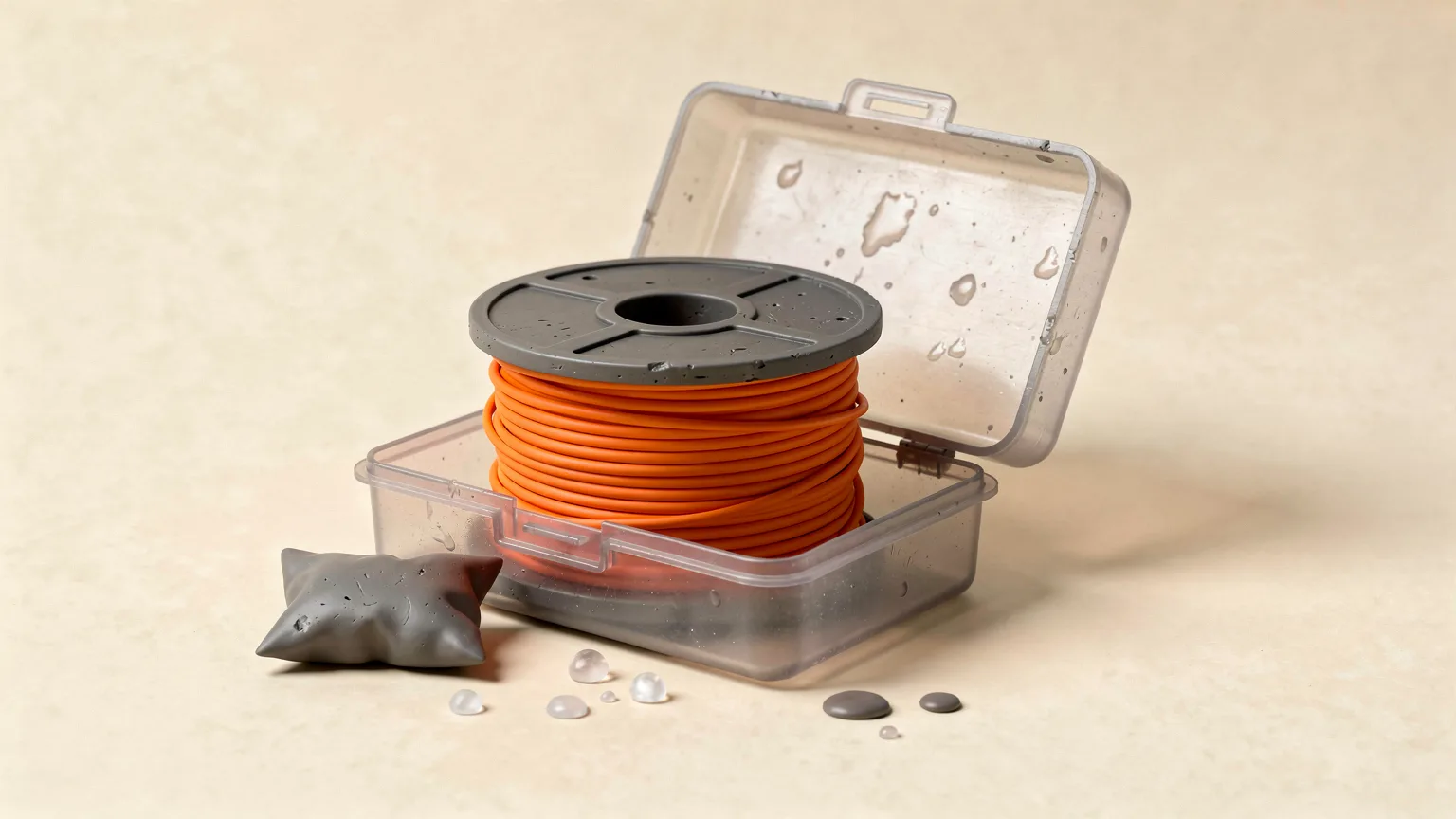
Filament does not carry a use-by date, and none of the maker product pages checked for this guide state a formal shelf life. What does happen is that most filaments slowly absorb water from the air, and wet filament prints badly. So a spool "expires" when it has taken on too much moisture or been stored badly, not when a calendar date passes.
This is a research article. It relies on maker documentation (listed in the sources) and does not draw on our own printing. Where a figure comes from a maker blog rather than a data sheet, the text says so.
The short answer
- There is no standard expiry date. The Bambu Lab PLA Basic, Polymaker PolyLite PLA and Prusament PLA product pages did not state a shelf life when checked on 2026-10-10.
- Creality's blog gives a general range of 6 months to 3 years for usable filament under proper storage. Treat that as a rule of thumb, not a guarantee.
- Moisture is the main cause of trouble. Both Bambu Lab and Prusa say to keep filament sealed with desiccant.
- Damp filament can usually be dried. Brittle or degraded filament usually cannot be rescued.
What actually goes wrong with old filament
Moisture
Prusa's knowledge base notes that most materials used for FFF printing are hygroscopic, meaning they attract water molecules from the environment. Bambu Lab explains the effect: absorbed moisture vaporizes in the hot nozzle, causing bubbles, stringing, oozing, holes, rough surfaces and reduced strength, and the effect gets worse as humidity rises and exposure lengthens.
How sensitive a material is varies. Prusa says PLA does not change properties much from taking up humidity, whereas polyamide (nylon) is affected quite significantly. It lists polyamide, polypropylene, PVA and BVOH as highly hygroscopic, and names polyamide, PVA and TPU as filaments that need drying more often than popular ones like PLA. The nylon filament guide covers that material in more detail.
Aging and storage damage
Creality's blog lists other signs of a degraded spool: powder and faded color on the surface, brittleness (the filament snaps rather than bends), rough extrusion with gaps and bubbles, and sizzling or popping sounds while printing. Heat and direct sunlight can also harm a spool, which is why makers advise a cool, dark, dry place.
Brittle filament is a separate problem from damp filament. Drying removes moisture, but it does not restore plastic that has become brittle.
Typical shelf-life ranges
These ranges are from Creality's blog. They are a general guide from one manufacturer, not a spec, and your results depend on storage.
| Material | Unopened | Opened and properly stored |
|---|---|---|
| PLA | 2 to 3 years | 3 to 6 months (longer in an airtight container with silica gel) |
| PETG | 2 to 3+ years | 1 to 2 years |
| ABS | 3 to 5+ years | 2 to 3 years |
| TPU | 2 to 3 years | 1 to 2 years |
| Nylon | 1 to 2+ years | 6 to 12 months |
Notice that "opened" times assume decent storage. Bambu Lab gives numbers that show why an open shelf is risky: at about 55% relative humidity, freshly dried filament will usually absorb enough moisture to affect print quality within about 2 to 12 hours depending on the material. Its wiki also warns that nylon-type filaments left in open air for around 3 months absorb so much moisture that they become very difficult to dry in a normal convection oven.
How to tell if a spool has gone bad
- Listen and look while printing. Popping, hissing, bubbles at the nozzle, or wispy strings point to moisture. Prusa says the first sign of humidity is usually poor surface quality, and sometimes low layer adhesion, blobs and bubbling.
- Check the surface of the finished print. Rough, fuzzy or pitted surfaces suggest damp filament.
- Bend a short piece. If it snaps cleanly instead of flexing, the spool may have become brittle.
- Rule out settings. Stringing also comes from temperature and retraction. The stringing guide shows what to check first.
- Dry it and compare. If a dried spool prints cleanly, moisture was the cause.
How to dry old filament
Bambu Lab recommends drying a spool first if you are unsure of its storage history, especially for parts that need good looks or strength. Its wiki lists drying conditions in a blast drying oven of 55 °C for 8 hours for PLA, 65 to 70 °C for 8 hours for PETG, 80 °C for 8 hours for ABS and ASA, and 70 °C for 8 hours for TPU. The Prusament PLA product page says drying is not usually necessary, but suggests 45 to 50 °C for 4 to 6 hours if you notice stringing, bubbling or surface roughness after long storage. These are different tools and starting points, so follow the guide for your dryer and material. Our how to dry filament guide goes through the steps, and the filament dryer buying guide helps pick equipment.
Do not use a kitchen oven or microwave. Use a purpose-made dryer and follow the manufacturer's temperature advice, because spools can deform at high temperatures.
How to make filament last
- Store spools in a sealed box or bag with desiccant. Bambu Lab says typical indoor air is 45% to 65% relative humidity, and that most filaments stay dry for only 2 to 7 days even at 20% relative humidity, so a sealed container matters.
- Put a small hygrometer in the box so you are not guessing.
- Replace or reactivate desiccant when it changes color. Bambu Lab's wiki says its color-changing beads turn from yellow to purple when saturated.
- Prioritize nylon, PVA, BVOH and TPU for the best storage.
- Buy only as much of fast-aging materials as you will use in a few months.
The full routine is in how to store filament. If you are working out how much plastic you will use before a spool runs out, see how long a spool of filament lasts.
Frequently asked questions
Does 3D printer filament have an expiration date?
There is no standard date. The Bambu Lab, Polymaker and Prusa PLA product pages checked on 2026-10-10 did not state a shelf life. Spools usually fail from moisture or poor storage rather than on a fixed date.
How long does PLA filament last?
Creality's blog gives 2 to 3 years unopened and 3 to 6 months once opened, longer in an airtight container with silica gel. Treat this as a general guide, since storage conditions decide the result.
Can you still use old filament?
Often yes, if it is only damp. Drying it according to the maker's guidance usually fixes stringing, bubbles and rough surfaces. If the filament snaps when bent, it has become brittle and is unlikely to print well.
How do I know if my filament is bad?
Look for popping or hissing at the nozzle, bubbles, stringing, rough surfaces, weak layers, powdery faded color, or a spool that snaps instead of bending. Dry the spool and reprint to see if moisture was the cause.
Which filaments go bad fastest?
Prusa lists polyamide, PVA and TPU as needing drying more often than common filaments like PLA, and notes polyamide, polypropylene, PVA and BVOH are highly hygroscopic. Store those sealed with desiccant.
Sources

Founder and editor
Software engineer since 2009 and Head of Engineering by day, a maker who has owned several 3D printers, writing practical guides to 3D printers, filament and running costs, with every article saying what was and was not tested.
Drafted with AI assistance, then edited and reviewed by Sepehr before it goes live. How we use AI.
Keep reading
Types of 3D Printer Filament: PLA, PETG, ABS, TPU and More
Six plastics cover most home printing, plus filled and specialty blends. Here is what each is good at, what it demands from your…
 AI illustration
Cheap vs Premium Filament: What Actually Differs
Premium PLA costs more than budget PLA, yet the stated tolerance is often the same. What the extra money buys when you compare…
 AI illustration
How Long Does a Spool of Filament Last?
A 1 kg spool holds about 349 meters of 1.75 mm PLA. Here is how to turn slicer weights into prints per spool, estimate how long…