Bambu Lab P1S vs P2S: Spec Comparison
The P2S refreshes the P1S with a hardened steel nozzle, a servo extruder, a touchscreen and an AI camera. Here is what changed, what did not, and the price gap.
By Sepehr Sabbagh-pour · Published 10 October 2026 · 6 min read
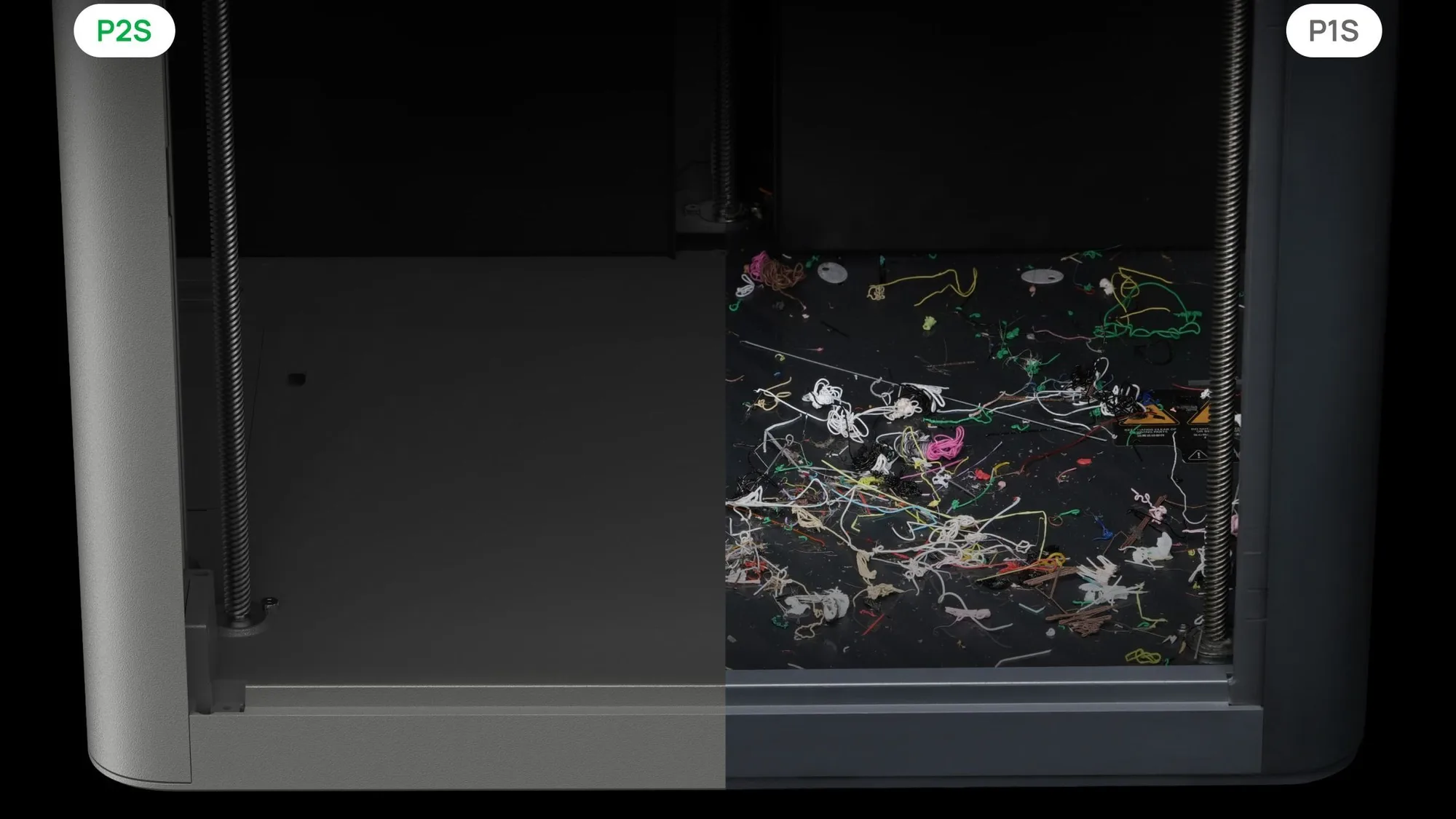
Research only. This comparison uses Bambu Lab's UK store pages for the P1S and P2S, Bambu Lab's launch blog post and the P2S wiki, read on 2026-10-10. Nozzle Notes has not tested either printer, so every performance statement is the maker's claim. The selection method: one maker's older and newer enclosed printers, with only figures that appear on a Bambu Lab page. Where the P2S spec sheet could not be read as text, the row says so.
The short answer
- Pick the P1S if you want a proven enclosed Bambu printer at the lower price. Bambu Lab says it has no plans to stop selling it.
- Pick the P2S if you want the newer hardware: hardened steel nozzle and gears, servo extruder, touchscreen, higher-rate camera, and support for the AMS 2 Pro with filament drying. It costs 120 GBP more as a bare printer on the UK store.
What was announced
Bambu Lab published its launch post, "The Icon Redefined: meet the P2S", on 14 October 2025. It describes the P2S as a "completely reengineered version" of the P1 series, and says it does not discontinue the P1S. The blog gives European prices of 519 EUR for the printer and 749 EUR for the Combo, tax included. A trade news report on the launch gives US prices of $549 and $799 (excluding tax); the Bambu store fetched for this article redirected to the UK store, so US store prices were not read directly.
P1S vs P2S specs side by side
| Spec | Bambu Lab P1S | Bambu Lab P2S |
|---|---|---|
| Build volume | 256 x 256 x 256 mm | 256 x 256 x 256 mm |
| Frame | Enclosed (plastic and glass) | Enclosed, shatter-safe front glass |
| Max hot end temperature | 300 °C | 300 °C (Bambu wiki) |
| Max build plate temperature | 100 °C | Heatbed range 35 to 110 °C (store footnote) |
| Nozzle and extruder gears | 0.4 mm stainless steel; carbon or glass fiber not recommended without a hotend upgrade | Hardened steel nozzle and extruder gears |
| Extruder | Standard | PMSM servo extruder, up to 8.5 kg extrusion force (70% more than predecessor) |
| Hotend | Standard | Quick-swap, one-clip design |
| Screen | Not listed on the page read | 5 inch touchscreen, second-generation UI |
| Camera | Low rate, 1280 x 720 at 0.5 fps | 1080P high-rate camera with added LED lighting |
| Error detection | Not listed | AI computer vision: spaghetti, nozzle clumping, purge chute jam, start check |
| Air handling | Activated carbon filter | Adaptive Airflow: cold air from outside the chamber, carbon filter, flap-controlled |
| Chamber heating | Chamber regulator fan; no heater listed | No active heating; Bambu claims a "50 °C chamber ready" design |
| Max AMS colors | Up to 16 (4 AMS units) | Up to 20 (4 AMS 2 Pro plus 4 AMS HT) |
| Filament drying | Not listed | Via AMS 2 Pro (combo) |
| X axis | Carbon rods | Smooth hollow steel rods |
| Max speed and acceleration | 500 mm/s, 20,000 mm/s2 | Check the current spec sheet; the table is not readable as text |
| Net weight | 12.95 kg | Check the current spec sheet |
What changed in daily use
Materials
The P1S page advises against printing glass fiber or carbon fiber filaments directly before an extruder and hotend upgrade. The P2S ships with a hardened steel nozzle and extruder gears, which Bambu Lab pitches for "stable, long-term printing of high-performance fiber-reinforced materials". If abrasive filaments are on your list, that is the clearest hardware difference. Our guide to hotends and nozzle materials explains why.
Extruder and quality claims
Bambu Lab claims the P2S servo extruder gives 70% more force and samples at 20 kHz to detect grinding and clogs. It also claims an eddy current sensor adjusts flow rate for consistent extrusion. These are marketing claims from Bambu Lab, and Bambu Lab's footnote says its P2S data comes from internal testing.
Cooling
The P2S Adaptive Airflow system pulls cool air from outside the chamber to cool the print, so low-temperature filaments can be printed with the door closed, Bambu Lab says. The P1S uses a chamber regulator fan and an auxiliary part cooling fan.
Multi-color and drying
The P2S Combo ships with the AMS 2 Pro, which Bambu Lab says adds filament drying with active venting. Drying in a box matters for wet filament; see how to dry filament.
Price gap
Bambu Lab UK store prices on 2026-10-10 (GBP):
| Version | P1S | P2S |
|---|---|---|
| Printer only | 329 GBP (struck-through 339 GBP) | 449 GBP (struck-through 479 GBP) |
| Combo with AMS | 469 GBP (struck-through 479 GBP) | 649 GBP (struck-through 699 GBP) |
The gap is 120 GBP for the bare printer and 180 GBP for the combo. The P2S combo includes the newer AMS 2 Pro, and the P2S also lists a Print with Care bundle. Prices change; check the store before buying.
Support period and the P1S question
The P1S page lists guaranteed bug fixes and feature updates until 13 July 2028 and security patches until 13 July 2030. The P2S page read for this article does not list a support date in readable text, so a comparison of support length is not possible. Bambu Lab says the P1S remains on sale with no plans to stop selling it, so the older printer is not being phased out by the launch.
Price movement is the other thing to watch. Both printers showed struck-through prices on 2026-10-10, which means they were on sale at the time. A sale price can end without notice, so the 120 GBP gap above may change. Nozzle Notes has not tested either printer, so print quality, noise and reliability are not compared. For the wider tradeoffs between enclosed and open machines, see enclosed vs open-frame printers.
Choose A if, choose B if
- Choose the P1S for the lowest price of a Bambu enclosed printer and PLA, PETG, ABS and ASA work.
- Choose the P2S for fiber-reinforced filaments, the touchscreen, the better camera, or the AMS 2 Pro with drying.
- For the open-frame alternative see A1 vs P1S, and for launch details the P2S first look and P1S first look.
Frequently asked questions
Is the Bambu Lab P2S better than the P1S?
On paper it adds a hardened steel nozzle and gears, a servo extruder, a touchscreen and a 1080P camera. Bambu Lab figures come from its own testing, and Nozzle Notes has not tested either printer.
Is the P1S being discontinued?
Bambu Lab said at the P2S launch that the P1S would remain available, and its P2S FAQ says there are no plans to stop selling it.
Do the P1S and P2S have the same build volume?
Yes. Both list a 256 x 256 x 256 mm print volume.
How much more does the P2S cost than the P1S?
On the Bambu Lab UK store on 2026-10-10 the P2S was 449 GBP and the P1S 329 GBP. The AMS combos were 649 GBP and 469 GBP.
Can the P1S print carbon fiber filament?
Bambu Lab advises against printing glass or carbon fiber filaments directly on the P1S before an extruder and hotend upgrade. The P2S ships with a hardened steel nozzle.
Sources

Founder and editor
Software engineer since 2009 and Head of Engineering by day, a maker who has owned several 3D printers, writing practical guides to 3D printers, filament and running costs, with every article saying what was and was not tested.
Keep reading
Anycubic Kobra S1: Specs, Price and Who It Suits
Anycubic Kobra S1 Combo specs, launch price and who it suits, from Anycubic's own pages. Not tested by us.
10 October 2026 · 5 min read
Bambu Lab A1: Specs, Price and Who It Suits
The Bambu Lab A1 is an open-frame 256 mm bed slinger sold from £209 in the UK store. Here are the maker's specs, prices and who it suits. Not tested by Nozzle Notes.
10 October 2026 · 5 min read
Bambu Lab A1 mini: Specs, Price and Who It Suits
The Bambu Lab A1 mini is the smallest and cheapest current Bambu Lab printer here at £149 in the UK store. Maker specs, prices and who it suits. Not tested by Nozzle Notes.
10 October 2026 · 5 min read