Best PLA Filament: 3 Brands Compared and What to Check
Three popular PLA filaments compared on maker-stated price, diameter tolerance and temperatures, plus what to check before you buy a spool.
By Sepehr Sabbagh-pour · Published · 5 min read
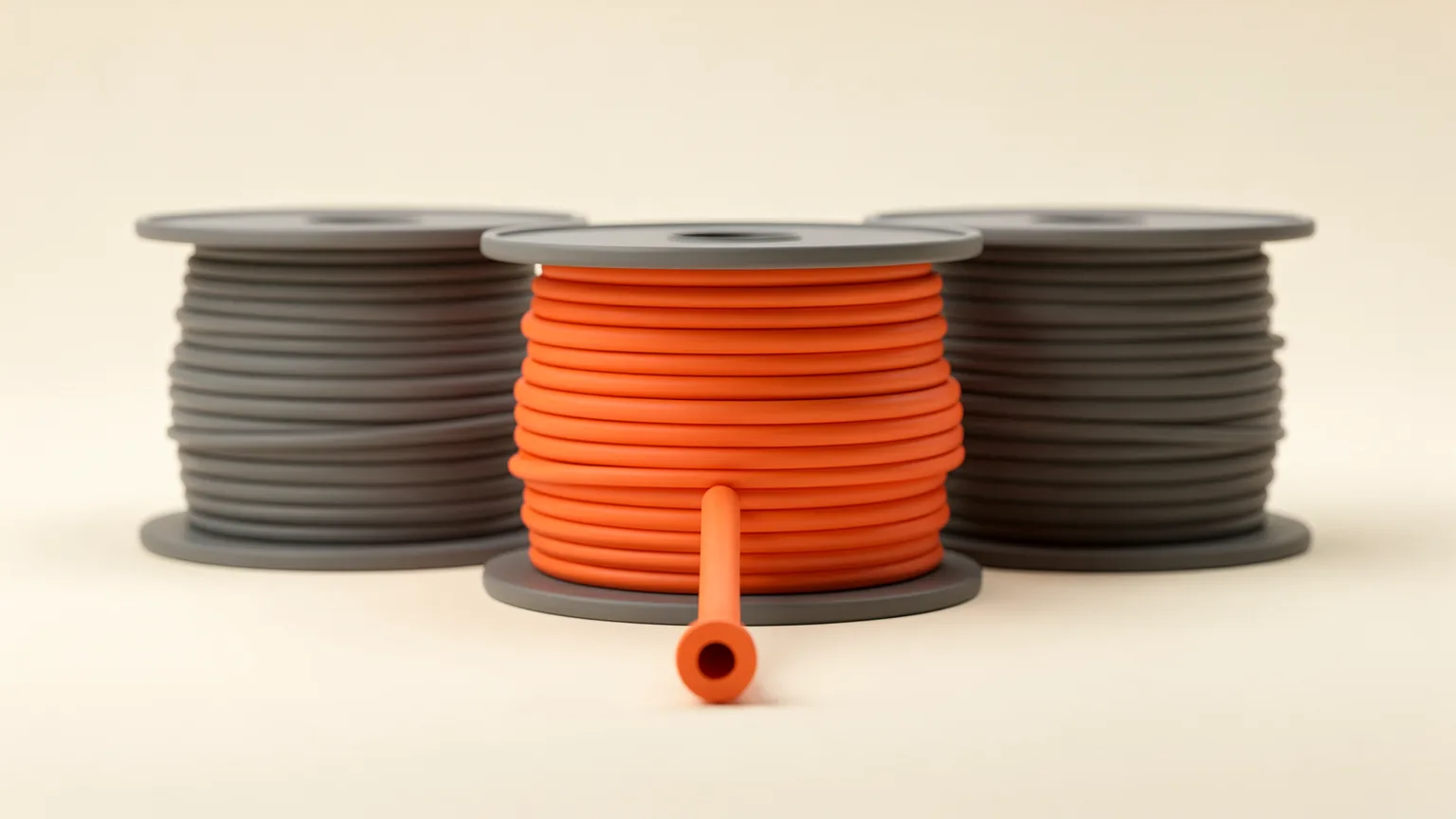
Prices checked .
The best PLA filament for most people is a mainstream 1 kg spool with a stated ±0.02 mm diameter tolerance: Prusament PLA ($29.99) if you want per-spool measurement data, Polymaker PolyLite PLA ($19.99) for a published data sheet, and ELEGOO PLA (from $13.99) for the lowest price. All figures come from maker pages.
Best PLA filament at a glance
Three widely sold 1.75 mm PLAs, each priced for a 1 kg spool on the maker's own US store page on October 13, 2026, in US dollars. The table is ordered by price, not by quality, and every figure is what the maker states.
| Filament | US price (1 kg) | Diameter tolerance | Nozzle range stated | Bed range stated | Pick this if |
|---|---|---|---|---|---|
| ELEGOO PLA | From $13.99 | ±0.02 mm | Not stated on the page | Not stated on the page | You want the lowest price and many colors |
| Polymaker PolyLite PLA | $19.99 | Not listed | 190 to 230 °C | 25 to 60 °C | You want a full published data sheet |
| Prusament PLA | $29.99 | ±0.02 mm | 215 °C | 50 to 60 °C | You want measured data for your own spool |
Prices change often and colors can differ in price, so confirm on the current listing. The Prusament price is for Galaxy Black, and the ELEGOO price is the lowest across the colors listed. This is a research-based shortlist of three, not a survey of every PLA on sale, and none of the three has been printed by Nozzle Notes.
What makes the best PLA filament?
The best PLA filament is one that is consistent: a steady diameter, dry material and a color that matches from spool to spool. Standard PLA from different makers is chemically similar, so these checks matter more than the brand name.
- Diameter tolerance. Look for a stated figure such as ±0.02 mm. A steadier diameter gives the extruder a steadier flow to work with.
- Published temperatures. A maker that states a nozzle and bed range gives you a starting point. See PLA print temperature for how to tune from there.
- Moisture protection. Vacuum sealing with desiccant is a good sign. Read how to dry filament if a spool prints badly.
- Spool and weight. Check the spool is 1 kg and fits your printer or dry box. Cardboard spools are lighter and, as ELEGOO notes, degrade faster than plastic.
- Price per kilogram. Compare 1 kg prices, not spool prices. The filament price guide shows typical US ranges.
One caution applies to all three: a maker's stated tolerance or temperature range is a claim, not a result you can verify from the page. Treat the comparison as a way to narrow the field, then let your own printer settle it.
Prusament PLA: who is it for?
Prusament PLA suits people who want proof of consistency. Prusa lists a diameter tolerance of ±0.02 mm, says diameter and ovality are measured along the full length of each spool, and says it publishes that data. Prusa states that it is the only filament manufacturer that does this, which is the maker's own claim.
The Galaxy Black page lists $29.99 for 1 kg, a 215 °C nozzle with a 0.4 mm brass nozzle recommended, and a 50 to 60 °C bed. Prusa says drying is not usually necessary and that the color follows a documented spectroscopic recipe, so reorders should match. It describes the material as low-warping for large models but hard and difficult to sand.
The downside is price: it is the most expensive of the three. Prusa also points to PETG, ASA or PC Blend for mechanically stressed or high-temperature parts, which is a useful reminder of PLA's limits.
Polymaker PolyLite PLA: who is it for?
PolyLite PLA suits people who like to see the numbers. Polymaker publishes a technical data sheet with a density of 1.17 g/cm³, a melting temperature of 150 °C and a Vicat softening temperature of 63 °C. The heat deflection temperature is 58 °C at 1.8 MPa and 60 °C at 0.45 MPa.
The same sheet lists a nozzle range of 190 to 230 °C, a build plate range of 25 to 60 °C and a drying setting of 55 °C for 6 hours. Tensile strength is 52.3 MPa in the X-Y direction and 40.5 MPa in Z, which shows that layer direction matters. Polymaker's shop lists $19.99 for 1 kg, $49.99 for 3 kg and $79.99 for 5 kg.
The data sheet does not list a diameter tolerance, so if that is your priority, look at the other two. The page also notes that some stock may be temporarily unavailable and points buyers to Amazon, so check availability before you plan around it.
ELEGOO PLA: who is it for?
ELEGOO PLA suits anyone who wants the lowest price per kilogram and plenty of color choice. ELEGOO's US store lists 1 kg spools from $13.99 and states a dimensional accuracy of ±0.02 mm, the same figure Prusa states.
ELEGOO says the filament is vacuum sealed with desiccant, dried before packing, wound on cardboard spools and made for low warpage and an odorless print. The page we read gives no nozzle or bed temperature, so use the temperature printed on the spool or the PLA ranges in our guide.
The trade-off is information: there is less published data here than from Polymaker or Prusa, and the figures are marketing claims rather than a data sheet.
How much does good PLA filament cost?
On the pages read, 1 kg of standard PLA cost between $13.99 and $29.99. That is a $16 spread, and the cheapest of the three is under half the price of the dearest. A $30 spool costs more per print, but the saving from the cheapest spool only matters if it prints as well on your machine.
To see what a spool means per part, use the print cost calculator and read cheap vs premium filament for what actually differs between price tiers.
Is PLA+ better than standard PLA?
PLA+ is not a standardized material, so it is not automatically better. Makers use the name for blends tuned for toughness or print speed, and the recipe differs by brand. Read the product page rather than relying on the label, and see PLA plus vs PLA for the details. Everything above is standard PLA.
When is PLA the wrong choice?
PLA softens at low temperatures. Polymaker lists a Vicat softening temperature of 63 °C and a heat deflection temperature of 58 °C at 1.8 MPa, so a part left in a hot car or near a heater can deform. Prusa recommends PETG, ASA or PC Blend for stressed or high-temperature parts. For help choosing, read PETG vs PLA and types of 3D printer filament.
Store PLA sealed and away from heat. Our guide to storing filament covers the basics, and silk PLA is a separate material with its own behavior.
How to choose PLA filament in four steps
- Pick a 1.75 mm spool unless your printer needs 2.85 mm, and check the weight is 1 kg.
- Prefer a maker that states a diameter tolerance and a temperature range.
- Compare the price per kilogram, not the price per spool.
- Buy one spool first, print a small test, and tune the temperature before you buy in bulk.
Where does this leave the shortlist? Buy Prusament for measured consistency, PolyLite for documented properties, and ELEGOO for price. None of them is proven better on your printer until you try it.
Frequently asked questions
What is the best PLA filament for beginners?
For a first spool, a mainstream 1 kg PLA with a stated diameter tolerance and temperature range is a safe choice. Of the three read here, ELEGOO PLA is the cheapest from $13.99, Polymaker PolyLite PLA at $19.99 publishes a full data sheet with a 190 to 230 °C nozzle range, and Prusament PLA at $29.99 publishes measured data for each spool. Prices were checked on October 13, 2026 in US dollars. None of these was printed by Nozzle Notes, so the choice rests on maker information. Start with one spool, print a small test and adjust the temperature before buying more.
How much does a spool of PLA filament cost?
On the maker pages read, a 1 kg spool of standard 1.75 mm PLA cost from $13.99 for ELEGOO PLA to $19.99 for Polymaker PolyLite PLA and $29.99 for Prusament PLA in Galaxy Black. Those are US dollar prices checked on October 13, 2026. Larger spools are cheaper per kilogram: Polymaker lists $49.99 for 3 kg and $79.99 for 5 kg. Prices change often and can vary by color, so confirm on the current listing and compare the price per kilogram, not the price per spool.
Does PLA filament need to be dried?
It depends on the maker and how the spool has been stored. Prusa says drying is not usually necessary for Prusament PLA, and ELEGOO says its PLA is vacuum sealed with desiccant after being dried before packing. Polymaker's data sheet lists a drying setting of 55 °C for 6 hours, which is useful if a spool has absorbed moisture. Keep PLA sealed when not in use, and dry it only if it starts to print badly, for example with popping sounds or rough surfaces. Our drying guide has the steps.
What temperature should I print PLA at?
Start with the range on the spool or the maker's page and adjust from there. Polymaker lists a nozzle range of 190 to 230 °C and a build plate range of 25 to 60 °C for PolyLite PLA, while Prusa lists 215 °C and a 50 to 60 °C bed for Prusament PLA. These are starting points, not guarantees, because printer, nozzle, speed and color all change the best setting. Print a small test, change the nozzle temperature in 5 °C steps and keep the one that looks cleanest.
Is expensive PLA filament worth it?
Sometimes. The extra cost buys things you can read on the page: a measured or guaranteed diameter, published data and consistent color between spools. Prusa, for example, publishes measurements for each spool. Whether that improves your prints depends on your printer, and a cheaper spool with the same stated ±0.02 mm tolerance may print just as well. This guide is built from maker pages and has not tested any of these filaments, so try a single spool of a cheaper brand before assuming you must pay more.
Sources

Founder and editor
Software engineer since 2009 and Head of Engineering by day, a maker who has owned several 3D printers, writing practical guides to 3D printers, filament and running costs, with every article saying what was and was not tested.
Drafted with AI assistance, then edited and reviewed by Sepehr before it goes live. How we use AI.
Keep reading
Types of 3D Printer Filament: PLA, PETG, ABS, TPU and More
Six plastics cover most home printing, plus filled and specialty blends. Here is what each is good at, what it demands from your…
PETG vs PLA: Which Filament Should You Use?
PLA is the easy default, PETG is the tougher all-rounder. Here is how they differ on temperature, strength, heat, warping and…
 AI illustration
PLA Plus vs PLA: Is It Worth Paying More?
PLA+ (also written PLA plus) is a marketing label for modified PLA, usually tougher and a little easier to print. Here is what…