PVA Filament: What It Is and When to Use It
PVA is a water-soluble support filament that dissolves after printing, leaving clean surfaces. Here is what it works with, what your printer needs and how to keep it dry.
By Sepehr Sabbagh-pour · Published · 5 min read
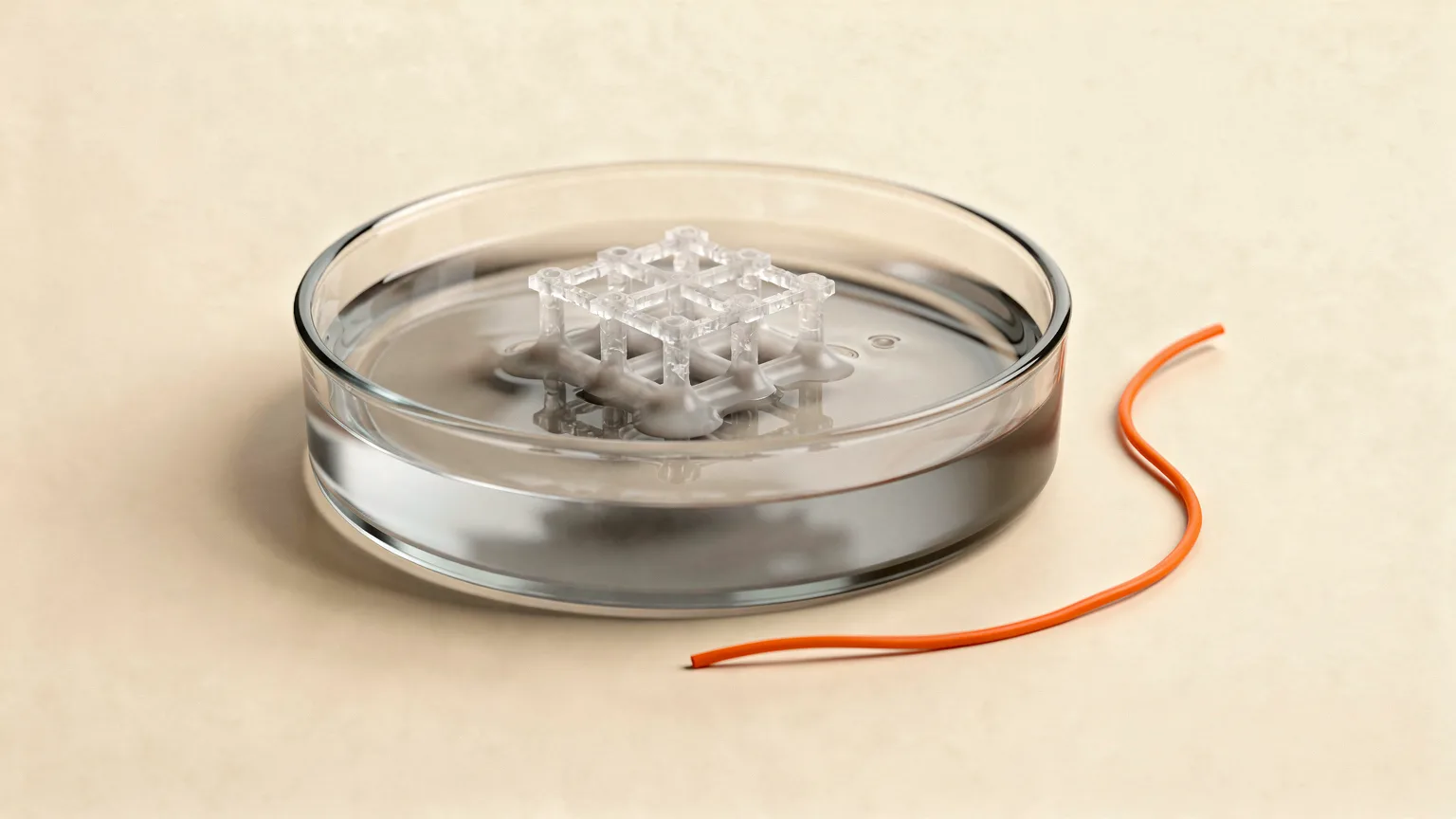
PVA support filament is a water-soluble 3D printing material made from polyvinyl alcohol. You print it as the support structure, then soak the finished part in water and the supports dissolve, leaving clean surfaces. It is worth using for hard-to-reach overhangs and internal cavities, if your printer can handle a second material.
What is PVA filament and how does it work?
Bambu Lab's wiki describes PVA as a flexible, biodegradable polymer that is highly sensitive to moisture and dissolves in liquid water. UltiMaker's technical data sheet calls its version a water soluble support material for dual extrusion printing, suited to complex models with large overhangs, deep internal cavities and intricate geometries.
The workflow has three steps. Your slicer prints the model in one material, usually PLA, and the supports in PVA. After printing, you immerse the part in water. The PVA dissolves, so no one has to pick, cut or sand supports out of tight spaces. For the basics of why supports exist at all, read 3D printing supports explained.
PVA is a support material only. Bambu Lab's guide notes that you can use it for both the support base and the support interface, and the same material can be used for the interface layer alone to save filament.
Which materials can PVA support?
Compatibility is the first thing to check, because PVA bonds well to some filaments and not at all to others. The makers do not agree on every material, so read the page for your exact spool.
| Maker | Listed as compatible | Listed as not suitable |
|---|---|---|
| UltiMaker PVA | PLA, PETG, Nylon | ABS, CPE+, PC, PP |
| Polymaker PolyDissolve S1 | Polymaker PLA, TPU, PVB and Nylon-based filaments | Not stated on its wiki page |
| Bambu Lab PVA | PLA (examples in its guide) | PETG |
Source: each maker's own documentation, listed under Sources. Note the PETG disagreement: UltiMaker lists PETG as a match, while Bambu Lab's guide says its PVA is not compatible as a support filament for PETG. The difference comes down to the specific PVA formulation and its print temperature, so treat the maker's compatibility list as the rule for that spool. If you are choosing the build material, see PETG vs PLA.
What does PVA need from your printer?
PVA is more demanding than ordinary filament, and the main requirement is a way to print two materials.
- Two materials in one print. That means a multi-material system such as the Bambu Lab AMS, a dual-nozzle machine, or a tool changer. Polymaker says single-nozzle printing is possible but not recommended, because of the clogging risk when switching materials, and it recommends IDEX or toolchanger setups. See multicolor 3D printing explained for how those systems differ.
- A dry filament path. Bambu Lab says damp PVA turns soft and sticky and is no longer suitable for the AMS or AMS lite.
- The right temperatures. Polymaker lists a 215 to 225 °C nozzle for PolyDissolve S1, while Bambu Lab's guide gives 240 to 250 °C for its PVA. Always use the figure on your own spool's documentation.
- Slow, careful printing. Polymaker advises printing PolyDissolve S1 no faster than 60 mm/s, or 8 mm³/s volumetric speed, with 1 to 3 mm of retraction.
Bambu Lab also advises avoiding tree supports with PVA, because they are tall, thin and unstable and can collapse during the print. It recommends normal grid supports. Our guide to the Bambu Lab AMS covers the feeding system itself.
How do you keep PVA filament dry?
You keep PVA dry by drying the spool before printing and then storing or feeding it from a sealed container with desiccant. This is the part that catches most people, because PVA absorbs water far faster than ordinary filament.
Bambu Lab's wiki says freshly dried PVA in a room at about 55% relative humidity gets damp in about 1 to 3 hours, enough to hurt print quality. In a 20% RH environment it stays dry for about 1 to 3 days. It recommends keeping humidity below 20% RH and using calcium chloride desiccant, because silica gel cannot keep PVA dry for a long time. Bambu Lab's product guidance lists drying at 80 °C for 12 hours.
Polymaker says the material is very hygroscopic and suggests running a heated filament dryer on its lowest setting for the whole print. Popping, cracking or bubbling while it extrudes means it needs drying. For general methods, see how to dry filament, how to choose a filament dryer and how to store filament.
UltiMaker describes its PVA as less moisture sensitive than other PVA filaments, but it is still a PVA and still needs protection from humid air.
How long does PVA take to dissolve?
PVA supports take a few hours to about a dozen hours to dissolve in water. Bambu Lab's guide says the process may take a few hours to a dozen hours, and Polymaker says supports typically dissolve in 6 to 12 hours depending on your setup.
Three things speed it up, according to those sources:
- Warmer water. Polymaker says boiling water is fastest if the parent material can tolerate it. Bambu Lab says that for PLA, the water should not exceed 50 °C, to avoid deforming the model.
- Moving water. Stirring or agitating the water helps. Polymaker suggests a pump, or rattling the build plate with a G-code.
- Fresh water. Polymaker says to change the water every few hours.
Bambu Lab also warns that most FDM prints have voids inside, so water can seep into the structure while soaking. Its wiki links a separate guide on reducing that risk. Plan for the part to need time to dry afterward.
Is PVA support worth using?
PVA is worth using when supports would be impossible to remove cleanly, such as internal channels, tight gaps between moving parts or delicate overhangs. It is usually not worth the trouble for simple parts, where ordinary supports with a good interface setting work fine. If your normal supports fuse to the print, try fixing supports fused to the print first.
| Question | Good fit for PVA | Probably skip it |
|---|---|---|
| Part geometry | Internal cavities, intricate overhangs | Flat bottoms, gentle overhangs |
| Printer | Multi-material or dual nozzle | Single nozzle, manual swaps |
| Build material | One the PVA maker lists as compatible | ABS, PC or PP (UltiMaker's not-suitable list) |
| Storage | Dry box with desiccant | Open shelf in a humid room |
Because PVA dissolves into the soak water, it is also a poor match for any part that must stay dry or that cannot be soaked for hours. Bambu Lab states its PVA is not food-contact grade, so do not use printed parts to hold or touch food.
Short version. Use PVA only if you have multi-material hardware, a dry storage setup and a build material the maker lists as compatible. Otherwise, ordinary supports are cheaper and simpler.
Sources and how this page was written
Everything above comes from the makers' own documentation, read in October 2026: Bambu Lab's PVA Printing Guide, Polymaker's PolyDissolve S1 wiki page and UltiMaker's PVA technical data sheet and material page. Figures differ between makers because each sells a different formulation. This page is research based, and a printer has not been used to print PVA for it.
Frequently asked questions
What is PVA filament used for?
PVA filament is used as a water-soluble support material. UltiMaker describes it as suited to complex models with large overhangs, deep internal cavities and intricate geometries. You print the supports in PVA and the model in another filament such as PLA, then soak the finished part in water until the supports dissolve. That avoids the marks left by pulling supports away by hand, and it reaches places a tool cannot, such as enclosed channels. It is for support only, not for printing standalone parts.
Is PVA the same as PLA?
No. PVA is polyvinyl alcohol, a polymer that dissolves in water, while PLA is a plastic that does not. They are often printed together because PVA bonds well to PLA, so PVA can be the support and PLA the model. Bambu Lab's wiki describes PVA as highly sensitive to moisture, and it should not be soaked until the print is finished. PLA parts are fine to soak, but Bambu Lab advises keeping the water at or below 50 °C to avoid deforming them.
How long does PVA take to dissolve?
Expect a few hours to about a dozen hours. Bambu Lab's guide says the dissolution may take a few hours to a dozen hours, and Polymaker says supports typically dissolve in 6 to 12 hours depending on your setup. Warmer water, moving water and changing the water every few hours all help. For PLA models, Bambu Lab says the water should not exceed 50 °C, because hotter water can deform the part. Check that the printed part is not leaking water into its interior.
How do you store PVA filament?
Store PVA in an airtight container with desiccant and dry it before you print. Bambu Lab says PVA is highly hygroscopic, recommends keeping humidity below 20% RH, and prefers calcium chloride desiccant because silica gel cannot keep PVA dry for long. It also says freshly dried PVA in a room at about 55% RH can get damp within 1 to 3 hours. Put the spool into the dry box straight after drying, without waiting for it to cool.
Can you print PVA on any 3D printer?
Not easily. PVA needs a way to print two materials in one job, such as a multi-material system, a dual nozzle machine or a tool changer. Polymaker says single-nozzle printing is possible but not recommended, because of the clogging risk when switching materials, and it recommends IDEX or toolchanger setups. The filament also needs a dry feed path, and Bambu Lab says damp PVA turns soft and sticky and no longer suits the AMS or AMS lite.
Sources

Founder and editor
Software engineer since 2009 and Head of Engineering by day, a maker who has owned several 3D printers, writing practical guides to 3D printers, filament and running costs, with every article saying what was and was not tested.
Drafted with AI assistance, then edited and reviewed by Sepehr before it goes live. How we use AI.
Keep reading
 AI illustration
3D Printing Supports: When You Need Them and Removal
Supports hold up parts of a print that start in mid-air. Learn when you need them, the main support styles, how to reduce them…
How to Dry Filament (and When You Actually Need To)
Wet filament causes stringing, rough surfaces and weak parts. Here is how to spot it, which drying methods are safe, temperatures…
Types of 3D Printer Filament: PLA, PETG, ABS, TPU and More
Six plastics cover most home printing, plus filled and specialty blends. Here is what each is good at, what it demands from your…