3D Printer Build Plates: PEI, Glass and Textured Compared
The build plate sets how well a first layer sticks and what the bottom of a print looks like. Compare smooth PEI, textured PEI, powder-coated and glass plates, with care tips.
By Sepehr Sabbagh-pour · Published · 5 min read
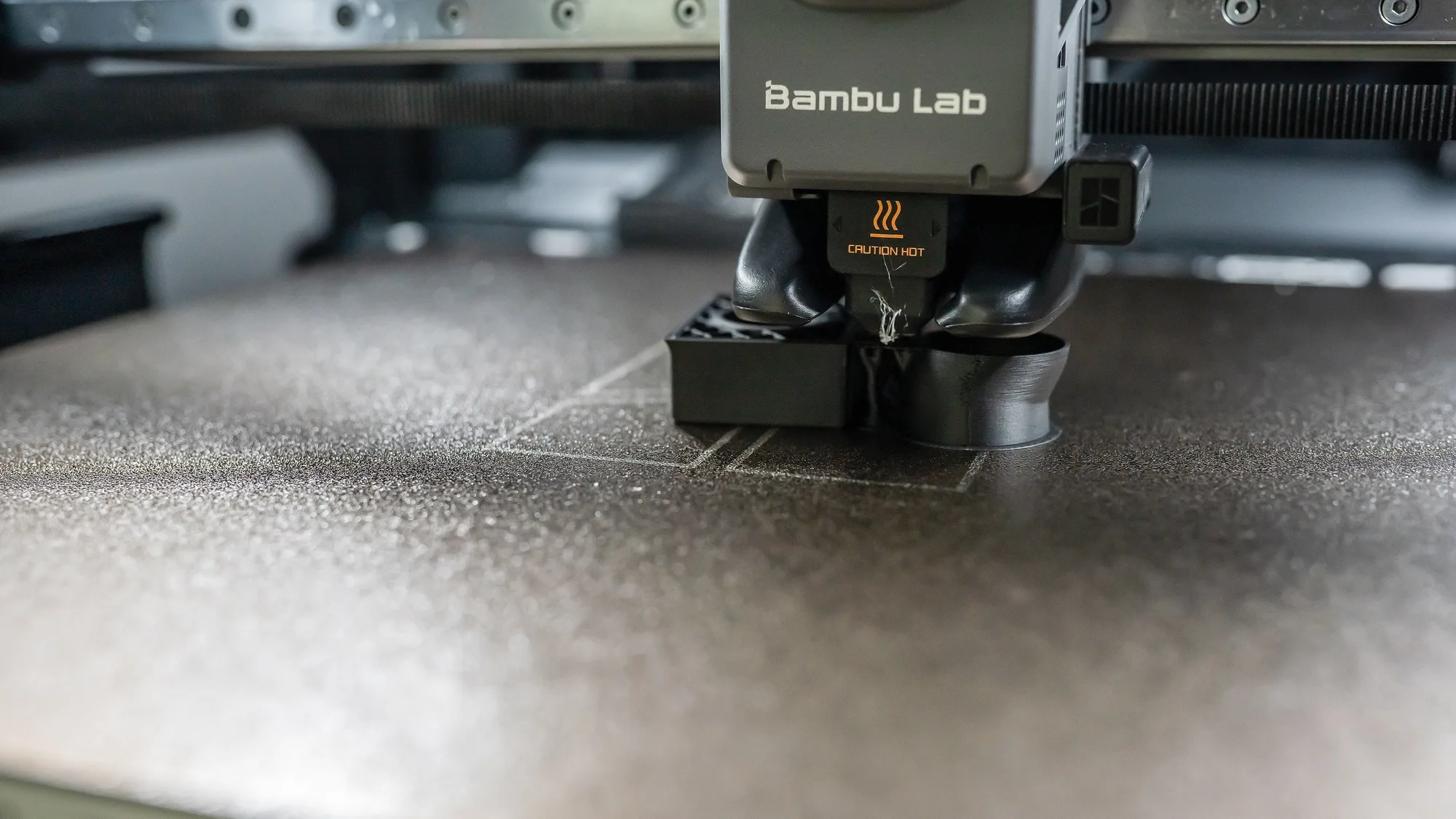
The build plate is the surface your first layer sticks to. It decides how well a print stays put while printing, how easily it comes off afterward, and what the bottom face looks like. Most modern printers use a flexible steel sheet with a PEI coating, and some use glass.
This is a research explainer built from maker documentation and store pages, checked on 2026-10-10. It is not a test, and the settings quoted are the makers' starting points.
The main build plate types
| Plate | Surface | Typical strength | Watch out for |
|---|---|---|---|
| Smooth PEI | Glossy sheet of smooth PEI plastic on spring steel | Strong grip on PLA, glossy bottom face, helps small contact areas stay put | PETG and TPU can stick too hard and damage the sheet |
| Textured PEI (powder-coated) | Matte, grainy PEI powder coating | Matte bottom face, releases PETG and flexible filaments more easily | Rougher underside; scratches easily |
| Satin powder-coated | Lightly textured matte finish, between smooth and textured | Works with a wide range of filaments | Acetone damages it |
| Glass (including coated glass) | Flat rigid glass, sometimes with a coating | Very flat, easy to clean and inexpensive | Rigid, so it cannot be flexed to release a print; makers' claims are not independent tests |
| Specialty sheets | Engineering, nylon, polypropylene and high-temperature plates | Made for materials that do not stick well to standard PEI | Often poor for everyday PLA or PETG |
Smooth PEI
Prusa describes its smooth sheets as steel covered with a smooth PEI plastic layer. Prusa says prints with a small area touching the surface, or with sharp corners, are less likely to detach on smooth sheets.
The same documentation warns that materials like TPU and PETG can adhere too much to a smooth sheet and can damage it when removed. Bambu Lab's table for its smooth PEI plate reflects that, listing a glue stick or liquid glue for PETG and TPU as a separation layer, but none for PLA.
Textured and powder-coated PEI
Textured plates use a rougher powder-coated PEI surface. Prusa says its textured sheet is better for PETG, CPE and flexible filament such as TPU, which tend to adhere too much to a smooth surface but are more easily removed from this one. It lists no need for a glue stick with TPU and TPEE on this sheet, and says ASA, ABS, nylon and polycarbonate need a glue stick as a separation layer.
Bambu Lab's textured PEI plate specification gives a PEI powder coating of 0.075 mm on a magnetic stainless steel plate, rated up to 180 C surface temperature. Its table lists no glue stick for PLA, PETG and TPU, and a glue stick for ABS, ASA, PC and nylon.
The trade-off is the finish. A textured plate leaves a matte, grainy texture on the underside of your print, while a smooth plate leaves a glossy one. If the bottom face is visible on the finished part, plate choice matters.
Satin and specialty sheets
Prusa also sells a satin powder-coated sheet. It describes the surface as lightly textured and matte, offering an optimal level of adhesion with a wide range of common and less common filaments. Its product page lists ABS, ASA, FlexFill 98A and polycarbonate among them, and notes polycarbonate may benefit from a glue stick.
For materials that do not stick well to standard PEI, Prusa lists a PA nylon sheet, a polypropylene sheet and a high-temperature sheet for materials like PEEK. Prusa says basic materials such as PLA or PETG do not adhere well to the high-temperature sheet. Bambu Lab sells an Engineering Plate for high-temperature filaments and says glue must be applied before printing.
Glass build plates
Glass is flat, rigid and easy to wipe clean. Creality describes its carborundum glass platform as a chemically tempered glass with a surface coating, and claims 0.15 mm flatness, strong adhesion when hot, and easy removal without tools once the bed has cooled. It also says the coating tolerates 400 C and can be cleaned with alcohol or acetone. These are the maker's own claims, not independent measurements.
Unlike a flexible steel sheet, a rigid glass plate cannot be bent to release a print, so wait for it to cool as the maker describes. Check that a glass plate suits your printer's bed size and temperature limits before ordering.
Match the plate to the filament
This table paraphrases Bambu Lab's plate tables for its textured PEI plate. The temperatures are the maker's suggested heatbed ranges, so treat them as starting points and adjust to your filament's data sheet.
| Filament | Heatbed temperature | Glue stick on textured PEI? |
|---|---|---|
| PLA, PLA-CF, PLA-GF | 45 to 60 C | No |
| PETG, PETG-CF | 60 to 80 C | No |
| TPU 85A and 90A | 35 to 45 C | No |
| ABS and ASA | 90 to 100 C | Yes |
| PC and PA (nylon) types | 90 to 110 C | Yes |
Bambu notes some entries are not for the A1 mini, which has a lower maximum plate temperature. See our guide to the types of 3D printer filament and PETG vs PLA for material behavior.
Cleaning, care and removing prints
- Let it cool. Prusa says always wait until the steel sheet cools to room temperature, then bend it in and out. A spatula may help. If a print is stubborn, Prusa suggests reheating the bed for a few minutes and letting it cool again.
- Clean with the right liquid. For Prusa's textured sheet, the instruction is about 90% isopropyl alcohol or denatured alcohol when cold. For stubborn residue, warm water with a few drops of dish soap, as a last resort and not often.
- Never use acetone on textured or satin sheets. Prusa's product page says acetone quickly deteriorates the surface by creating microfractures in the texture. Prusa also says never to apply ABS juice or put the sheet in a freezer.
- Do not use metal spatulas on textured sheets. Prusa describes them as not scratch-resistant.
- Treat plates as consumables. Prusa states print sheets are not covered by warranty because the coatings diminish over time. A spare plate is one of the first printer upgrades worth making.
- Re-level after swapping plates. Prusa says live Z must be readjusted when switching sheets on PINDA-equipped printers; follow your own model's guide when changing sheets.
If prints will not stay down, start with fixing a bad first layer and fixing prints that do not stick.
If you only read one thing. A textured PEI sheet is the simplest all-round choice for PLA, PETG and TPU. Keep acetone away from it, let it cool before removing prints, and use a glue stick as a separation layer for ABS, ASA, PC and nylon.
Related reading
Plate size must match the printer, so see build volume explained. Bed level also matters: our guide to leveling a printer bed covers it.
Frequently asked questions
What is the best 3D printer build plate?
There is no single best plate. Textured PEI is a common all-round choice for PLA, PETG and TPU, smooth PEI gives a glossy bottom face, and glass is flat and cheap. The right one depends on your filament and the finish you want.
Do I need glue stick on a PEI plate?
Often not for PLA, but it depends on the plate and filament. Bambu Lab's tables list no glue for PLA on textured PEI and glue for ABS, ASA, PC and nylon. Prusa says glue can also act as a separation layer for materials that bond too strongly.
Can I clean a PEI build plate with acetone?
Not textured or satin powder-coated sheets. Prusa says acetone deteriorates the surface. For Prusa textured sheets, use about 90% isopropyl alcohol or denatured alcohol when the plate is cold, and follow the instructions for your own plate.
Why is my print stuck to the build plate?
The plate may be bonding too well, as can happen with PETG or TPU on a smooth PEI sheet. Let the plate cool to room temperature, flex it, and consider a separation layer such as a glue stick or a textured plate.
How long do build plates last?
They wear out. Prusa describes print sheets as consumables whose coatings diminish over time, so they are not covered by warranty. No maker lifetime figure was found, so replace a plate when adhesion or surface condition gets worse.
Sources

Founder and editor
Software engineer since 2009 and Head of Engineering by day, a maker who has owned several 3D printers, writing practical guides to 3D printers, filament and running costs, with every article saying what was and was not tested.
Drafted with AI assistance, then edited and reviewed by Sepehr before it goes live. How we use AI.
Keep reading
Build Volume Explained: How Big a Printer Do You Need?
Build volume is the largest box a 3D printer can fill, given as width, depth and height. Here is how to read the number, what…
3D Printer Nozzle Sizes: 0.2, 0.4, 0.6 and 0.8 mm Compared
The standard 0.4 mm nozzle is a good all-rounder, but swapping size trades detail for speed and strength. Here is what changes…
What Can You Make With a 3D Printer?
From brackets and hooks to miniatures, phone cases and prototypes: a practical look at what home 3D printers make well, which…