How to Recycle 3D Printer Filament and Failed Prints
Failed prints, supports and purge waste can often be recycled, but not in your household bin. Here is how to sort it, where to send it and how to make less of it.
By Sepehr Sabbagh-pour · Published · 5 min read
Prices checked .
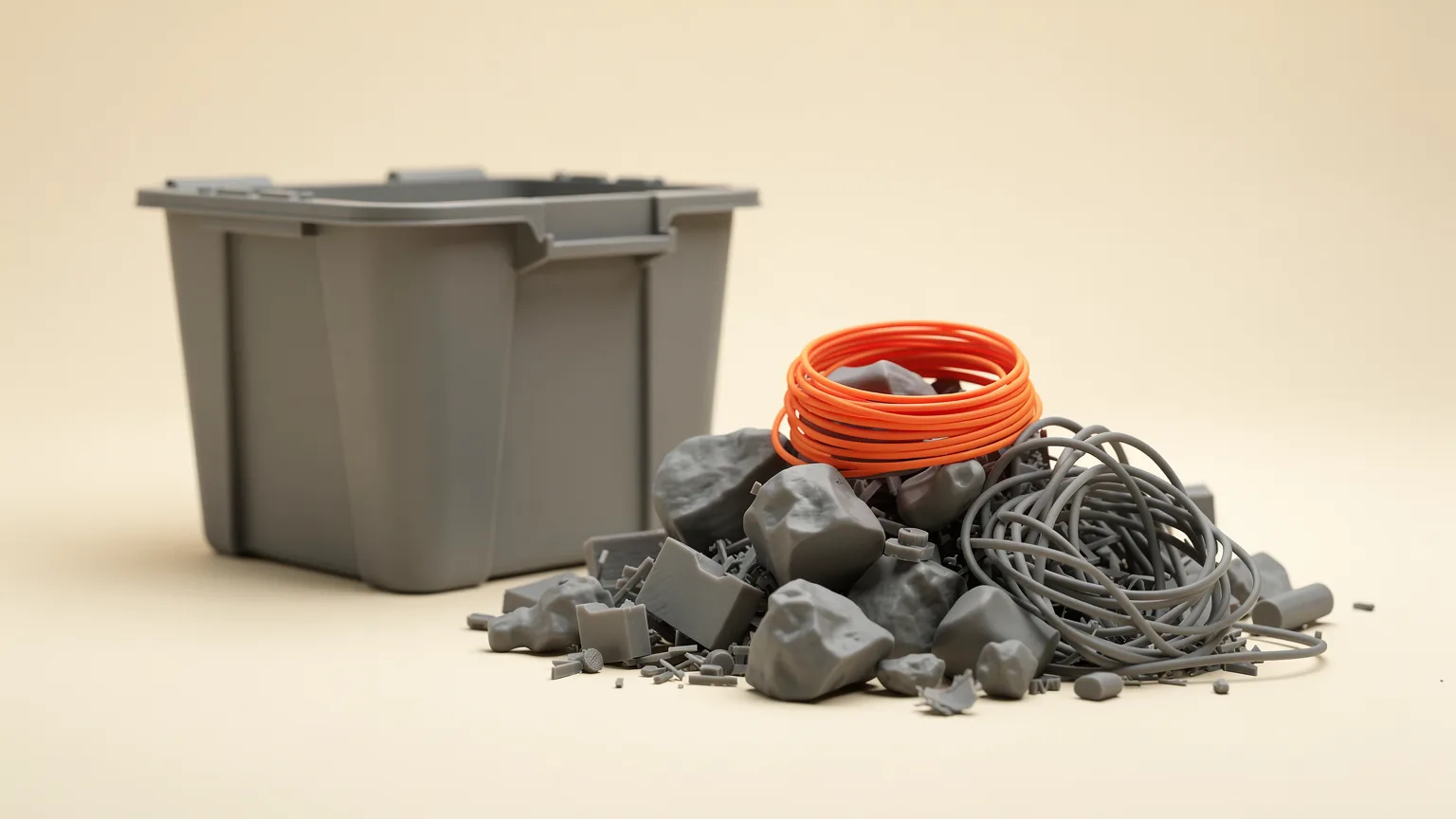
To recycle 3D printer filament, sort your failed prints, supports and purge waste by material, keep them clean and dry, then send them to a recycler or a filament-reclaim scheme. Making new filament at home needs a shredder and an extruder, which is costly and hard to do consistently.
Can you recycle 3D printer filament and failed prints?
Yes, but not in your household recycling bin. Most plastics in a failed print are not accepted by curbside collections, and an Adafruit tutorial on recycling failed prints notes that most recycling centers will not take unlabeled prints. The workable routes are a specialist recycler, a manufacturer or retailer scheme, or reusing the plastic yourself.
Prusa says print waste is valuable to recyclers because, when collected directly and on a small scale, it is homogeneous, clean and has a more or less predictable composition. That only holds if you keep it that way, which is why sorting matters more than anything else in this guide.
How do you prepare print waste for recycling?
Good preparation decides whether anyone will take your waste. Follow these steps:
- Sort by material. Keep PLA, PETG, ABS and every other filament in separate containers. Mixed plastics melt at different temperatures and make poor recycled filament.
- Separate colors if you can. A recycler may accept mixed colors, but ask. Each listing on Prusa's map says which materials that recycler needs.
- Remove everything that is not that plastic. Pull off tape, glue stick residue, brims stuck to other materials, metal inserts and magnets. Soluble supports such as PVA do not belong in a PLA bin. See what PVA support filament is for why it behaves differently.
- Keep it dry. Wet plastic is harder to process, and many filaments absorb moisture from the air. Store waste in a sealed box, as you would a spool, following how to store filament.
- Label the box. Write the material on it. Unlabeled scrap is the thing recyclers turn away.
Resin waste is a different case. Cured resin and uncured resin should be handled as the resin maker instructs, so see resin 3D printing safety and do not mix it into filament waste.
Where can you send 3D printing waste?
There are three main options, and which one works depends on where you live.
| Option | What it is | What to check |
|---|---|---|
| Prusa World Map recycler | Small-scale recyclers from the Prusa and Precious Plastic communities | Materials accepted and contact details on each listing; coverage is sparse |
| Retailer or maker scheme | Filamentive advertises free recycling of PLA waste for eligible Bambu Lab users | Eligibility and countries, which its page does not state in full |
| Local makerspace or school | Some, such as the University of Edinburgh's uCreate studio, collect purge and waste filament and send it off to be recycled | Ask whether they accept outside waste |
Prusa's World Map has a filter for small-scale plastic recycling projects. Each listing describes the project, the materials it needs and how to contact it. Prusa admits that these projects are still few and far between, so check the map for your area before assuming there is a nearby option.
Prusa also strongly recommends recycling PLA even though it is often called biodegradable. According to Prusa, PLA breaks down only in industrial composting plants, which are rare, and it does not break down in home compost. Do not put it in your compost heap.
Can you turn failed prints into new filament at home?
You can, but it is a project rather than a chore. The process described in the Adafruit tutorial is to collect failed prints, crush or shred them into small pieces, then feed the pieces into a filament extruder such as a Filabot. A caliper is on its tool list for checking the result.
Cost and effort are the catch. On the date checked below, Filabot lists its Full Recycling Setup (a Reclaimer, an EX3 or EX6 extruder, an Airpath cooling unit, a Spooler and a Pelletizer) at $27,595 on sale, and says the workflow is reclaim, prepare, extrude, cool, spool and print. That is a lab-scale system, not a hobby purchase.
Consistency is the other problem. Prusa describes its own Prusament PLA Recycled as made entirely from spools that failed its quality control, with no additives or pigments, a looser diameter tolerance of plus or minus 0.05 mm and imperfect winding. If a filament maker with industrial equipment accepts a looser tolerance on recycled spools, expect the same or worse at home. Check filament diameter basics before trusting any home-made spool.
Buying recycled filament is the easier way to close the loop. Prusament PLA Recycled comes on a 2 kg spool, which needs a 125 mm spool holder, and each batch has its own color because it depends on the spools mixed in.
How do you reduce 3D printing waste in the first place?
The cheapest recycling is not making the waste. Most of it comes from failed prints, supports and multicolor purging, and each has a fix:
- Cut purge waste on multicolor printers. The uCreate guide for Bambu Studio suggests lowering the flushing volume multiplier (it accepts 0.00 to 3.00) while keeping values out of the red, flushing into the infill and supports of the model, or adding a small extra object to absorb the purge. See multicolor 3D printing explained and the Bambu Lab AMS guide.
- Print single-color parts separately. Fewer color changes means less waste and shorter prints.
- Prevent failures. A spaghetti failure can waste an entire spool section. Fixing spaghetti failed prints covers the usual causes.
- Use fewer supports. Reorienting a part often removes them, as supports explained shows.
- Reuse small offcuts. Short ends of filament can go into small projects, test prints or as tie-offs instead of the bin.
Waste also affects what a print really costs. Our 3D printer running costs guide and the print cost calculator let you add a failure allowance to your estimates.
What should you not recycle?
Keep out anything you cannot identify, filament mixed with other materials, burnt or discolored scrap that smells strongly, and soluble supports. If a piece has no clear label, put it in the general waste or ask a recycler before sending it. Follow local rules for disposal, and see the manufacturer's guidance for any material you are unsure about.
Short version. Sort by material, keep it clean and dry, check Prusa's World Map or your retailer for a take-back scheme, and cut waste at the slicer first. Home filament making is a project, not a shortcut.
This guide is based on maker and recycler documentation listed below; prices were read on the Filabot page on the date shown at the top.
Frequently asked questions
Can you recycle 3D printer filament at home?
Yes, but it takes equipment. The usual process is to sort failed prints by material, shred them into small pieces and feed them through a filament extruder, then check the diameter with a caliper. Filabot lists a full recycling setup for $27,595, so it is a lab-scale investment. Even Prusa's own recycled filament, made from rejected spools, has a looser diameter tolerance of plus or minus 0.05 mm. For most hobbyists, sorting waste and sending it to a recycler or a take-back scheme is more practical than extruding new filament at home.
Can you put failed 3D prints in the recycling bin?
Usually not. An Adafruit tutorial on recycling failed prints notes that most recycling centers will not accept unlabeled prints, and household collections are set up for labeled packaging. Instead, sort the waste by material and look for a specialist recycler on Prusa's World Map, a retailer scheme such as Filamentive's PLA recycling for eligible Bambu Lab users, or a local makerspace. Always check your local rules before putting 3D printing waste into a general recycling collection.
Is PLA biodegradable, and can you compost it?
Not at home. Prusa says PLA can only be processed in industrial composting plants, which are rare, and that it does not break down in home compost, so it should not go in your compost heap. Prusa stopped describing its PLA filaments as biodegradable in 2022 and strongly recommends recycling PLA instead. Some countries have dedicated bioplastic composting facilities, so local options vary, but the safe default is to sort PLA waste and send it to a recycler that accepts it.
How do you reduce purge waste on a multicolor 3D printer?
Lower the flushing volume multiplier in your slicer while keeping the values out of the red, and flush into the infill and supports of the model so the purged filament is used rather than discarded. You can also add a small extra object to the plate to absorb the purge, and print solid single-color parts separately so there are fewer color changes. These steps come from the University of Edinburgh's uCreate guide for Bambu Studio and apply the same idea to other multicolor slicers.
What should you do with leftover filament?
Keep usable leftovers in a sealed box with desiccant, labeled by material and color, and use them for small prints, test pieces or the first layers of multi-material jobs. Scraps too short to use should be sorted by material and added to your recycling box instead of the trash. Do not mix different plastics in the same bin, because recyclers value 3D printing waste for being clean and predictable, and mixed waste loses that value.
Sources

Founder and editor
Software engineer since 2009 and Head of Engineering by day, a maker who has owned several 3D printers, writing practical guides to 3D printers, filament and running costs, with every article saying what was and was not tested.
Drafted with AI assistance, then edited and reviewed by Sepehr before it goes live. How we use AI.
Keep reading
Types of 3D Printer Filament: PLA, PETG, ABS, TPU and More
Six plastics cover most home printing, plus filled and specialty blends. Here is what each is good at, what it demands from your…
 AI illustration
How to Fix Failed Resin Prints
Most failed resin prints trace back to a short list of causes. Match what you see to the likely cause, change one thing at a time…
 AI illustration
Nylon 3D Printer Filament: What It Is and What It Needs
Nylon is tough, slippery and heat tolerant, but it needs a hot nozzle, a dry spool and usually an enclosure. Here is what it is…